
Local councils across the UK are facing a financial cliff edge. As statutory service demands skyrocket and central funding constricts, issuing a Section 114 notice – effective local government bankruptcy – is a looming threat for many authorities. The struggle to translate digital efforts into hard cash is systemic. The LGA’s State of the Sector: AI report tracks how English councils are using AI. Councils are putting money into tools like Microsoft Copilot and automation platforms on the assumption that vendor-reported “hours saved” equal financial savings. They do not. Saving a planning officer 30 minutes a day on drafting emails does not balance a budget unless that time is explicitly captured and reallocated to frontline needs.
To prove value for money and defend your innovation budget to the Section 151 officer, you need to count cashable and non-cashable savings separately, using your own data rather than vendor vanity metrics, and track what happens after the technology goes live with a monthly forecast-vs-actual review. SilkFlo helps councils move from guessing about “hours saved” to tracking actual capacity released, so Heads of Digital can show how their investments keep the council financially resilient.
Why Vendor Figures Overstate Council AI Savings
Allowing your automation or AI vendor to report on your Return on Investment (ROI) is a bit like letting a student grade their own exam. You naturally receive a highly optimistic view of value, one that is usually designed to justify your next license renewal. It quietly drains public sector innovation budgets.
The Disconnect Between “Time” and “Budget”
Let’s look at a common scenario (illustrative figures): a council purchases 1,000 Microsoft Copilot licenses at roughly £360 per user annually. The baseline operational expenditure (OpEx) immediately increases by £360,000.
To justify this spend, vendors often use theoretical math: “If Copilot saves 1,000 employees just one hour a week and their average hourly rate is £25, you are saving £1.3 million a year. Your ROI is massive!”
As anyone in local government knows, this is a phantom metric. You cannot pay down a £15 million adult social care deficit with fractional hours saved by marketing officers or HR administrators. Unless those “saved hours” result in a measurable absorption of new statutory demand, the financial savings are exactly zero. The council simply ends up with a slightly less stressed workforce and a £360,000 hole in its IT budget.
This disconnect is the main reason councils feel they are not seeing the gains they expected. Moving beyond “efficiency” to financial return needs IT deployment and corporate finance reporting to be joined up, with cashable and non-cashable savings recorded on separate lines.
The Hidden Cost of Chatbots
Chatbots are a common example. When a new AI deployment – such as a citizen-facing housing query bot – fails to reach 100% autonomous resolution, the council still has to keep its human customer service agents as a fallback.
Because the Total Cost of Ownership (TCO) isn’t being rigorously tracked in one place, the council ends up paying for both the AI software licenses and the human labour it was supposed to assist or replace. Operational costs go up, output remains static and Value for Money completely evaporates.
The Framework: Moving from “Hours Saved” to “Capacity Released”
When you are trying to get a project past the Chief Executive, you have to fundamentally change how you talk about value. You have to stop talking about general “efficiency” and start measuring Capacity Released. You can model it for your own council with our AI ROI calculator.
Defining “Capacity Released”
Capacity Released is the quantifiable ability of a department to absorb increasing statutory demand – such as processing a 20% spike in housing benefit applications or managing complex adult social care case files – without needing to hire more staff.
But how do you actually measure this without drowning in spreadsheets? You have to look beyond just asking staff if they feel “faster.” In SilkFlo, each initiative is assessed against six value drivers instead of vague estimates of time saved:
- Cost: Hard cash removed from the operational baseline.
- Revenue: Additional income generated or recovered (e.g., automating council tax arrears processing).
- Risk: Financial penalties avoided (e.g., maintaining GDPR compliance or meeting statutory timelines).
- Customer Experience (CX): Reductions in citizen wait times and complaint volumes.
- Employee Experience: Reduction in staff burnout, turnover and associated recruitment costs.
- Productivity (Capacity Released): The exact volume of new statutory workload absorbed by the technology.
A Business Case Finance Will Respect
When budget cuts loom, innovation teams are usually the first on the chopping block because their business cases rely on soft, untrackable metrics. To protect your projects, you need to structure your business cases in a way that finance actually respects.
SilkFlo’s Business Case Builder structures each case around the three things finance asks about:
- One-off costs: implementation, discovery workshops and external consultancy.
- Running costs: software licences (Copilot, UiPath, Power Automate), cloud costs and the officer time to run them.
- Value: the forecast impact against the six value drivers, with cashable and non-cashable savings shown separately.
When you build a business case this way, it stops looking like an IT spending request and starts looking like a strategic financial asset.
Cashable and Non-Cashable Savings: How to Count Both in 3 Steps
Councils often treat only cashable savings as real, which undercounts AI. Most AI benefit arrives first as freed capacity: officers handle more work without extra staff. Counting cashable and non-cashable savings properly means recording each type with the same discipline, because finance will test cashable and non-cashable savings in different ways.
| Type | What it means | Council example | Evidence |
|---|---|---|---|
| Cashable saving | A budget line goes down | Agency spend in revenues falls | Finance ledger, before and after |
| Cost avoidance | Planned spending no longer happens | A planned post is not created because demand was absorbed | The approved growth bid or workforce plan |
| Non-cashable saving | The same budget delivers more or better | More housing benefit claims processed by the same team | Volume and unit cost from the case system |
- Agree the rules with finance first. Decide which unit costs to use for officer time and which budget lines count as cashable, before any figures are reported.
- Record what freed time became. For every initiative, write down whether hours went into backlog, new demand, better quality or a lower budget. Hours that disappear into the working day are neither cashable nor non-cashable savings.
- Report the lines side by side, monthly. Show cashable savings, cost avoidance and non-cashable savings separately, and move a benefit from non-cashable to cashable only when a budget line actually falls.
Recorded this way, cashable and non-cashable savings stand up next to each other in front of members and the external auditor. The glossary entry has a short definition you can share with colleagues, and the free AI ROI calculator helps you size both before a business case goes for approval.
Systems of Work vs. Systems of Value
If you look at the typical enterprise technology stack today, there is a glaringly missing layer. Councils have invested heavily in platforms to manage the work, but they lack a platform to manage the value.
Why Jira, ServiceNow and MS Planner Fail at Value Tracking
You likely already use tools like Jira, ServiceNow, or Microsoft Planner. Those are brilliant Systems of Work. They are exceptionally good at telling you if a ticket was closed, a workflow was mapped, or an app was deployed.
But they are totally blind to your budget. Closing an IT ticket for a “new automated planning workflow” does not tell the Section 151 Officer if that workflow actually delivered its forecasted £50,000 in Capacity Released six months later.
SilkFlo: One Place to Track Value
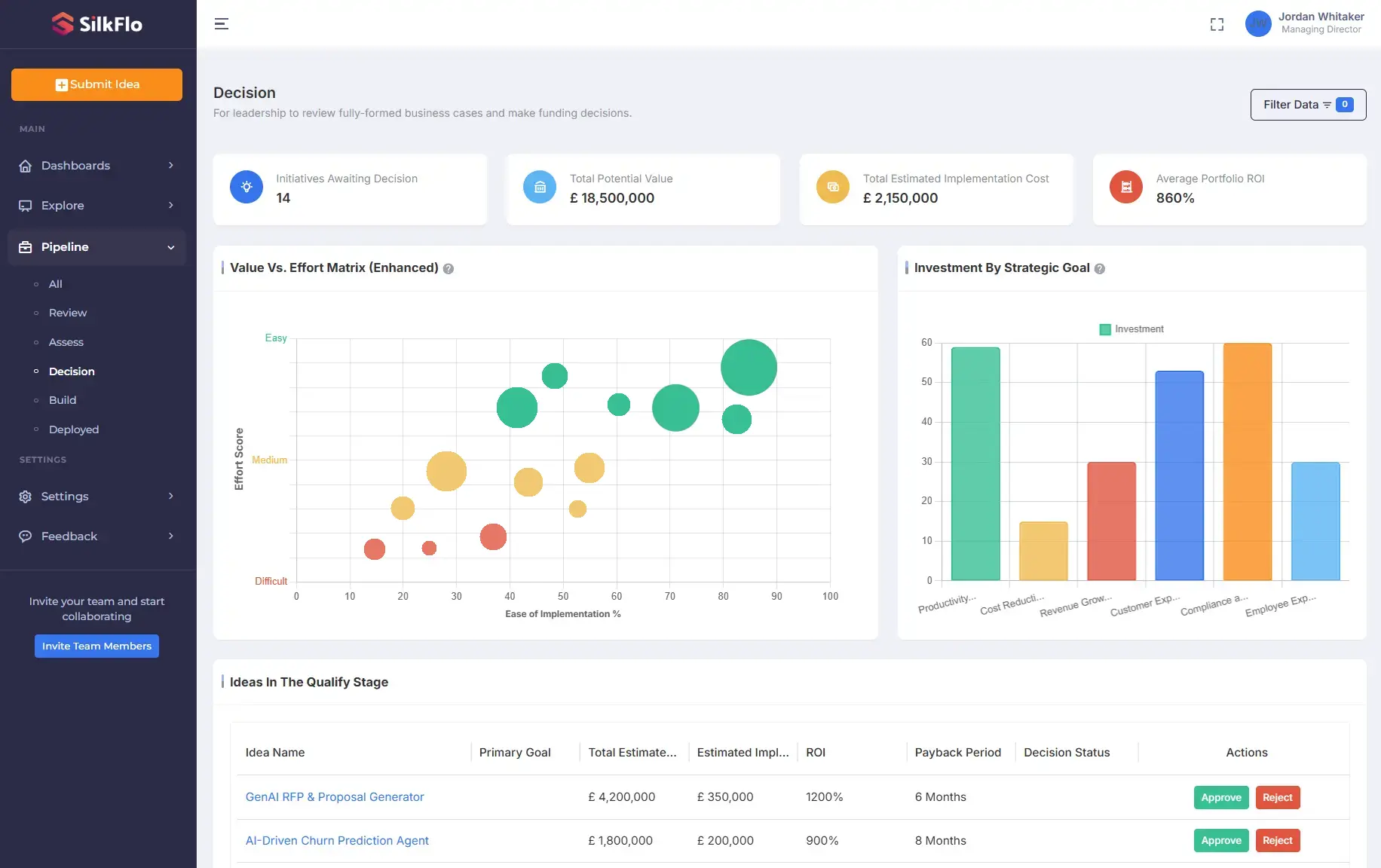
You need a system that tracks value, not just work. SilkFlo sits right above your execution layer to answer one simple question: Did this project actually deliver the financial impact we promised in the business case?
We do this with a monthly forecast-vs-actual review. If you forecast £100,000 in value over 12 months, SilkFlo compares that with actual results pushed in from your own systems after go-live. It holds both the technology and the business unit accountable without the usual manual reporting headache.
Staffordshire County Council
Staffordshire County Council uses SilkFlo to track UiPath, Power Automate and Microsoft Copilot in one place that no vendor controls, so the question of what each investment delivered is answered outside any supplier’s own reporting.
Standardising the Council Innovation Pipeline Ahead of LGR
If your council is facing a Local Government Reorganisation (LGR), the pressure to prove ROI gets even heavier. When districts and counties merge into new unitary authorities, digital IP usually gets lost in the chaos. You end up with orphaned automations, duplicated software licenses and millions lost in Shadow IT.
Before a merger kicks off, you need a single, agnostic view of everything you own – a Digital Asset Register.
Recording every business case and AI deployment in SilkFlo in one standard format means the portfolio is documented the same way across every team. When staff submit ideas through AI-assisted intake, each one is classified by value driver and given an ROI estimate.
If a merger goes ahead, the new authority starts with one view of the combined portfolio: which duplicate licences to cut, which overlapping projects to stop and which high-value initiatives to scale, with cashable and non-cashable savings from consolidation recorded from the start.
If you are looking for further evidence of what good looks like, the LGA artificial intelligence hub shares case studies and learning from other councils. Comparing these peer examples against your own pipeline in SilkFlo allows you to ensure your local initiatives are aligned with the national best practices for council digital transformation.
Conclusion: Defending Your Transformation Budget
The era of funding digital transformation based purely on “improved citizen experience” and theoretical “hours saved” is over. Public sector budgets are too fragile and the stakes for statutory services are too high. To protect your team and ensure your council’s digital services don’t stagnate, you have to speak the language of finance.
It is time to stop judging AI by the vendor’s own numbers, and to move from tracking tasks in Systems of Work to checking actual financial impact, with cashable and non-cashable savings reported side by side.
SilkFlo provides the supportive, authoritative infrastructure you need to make this transition. By running a monthly forecast-vs-actual review and standardising your pipeline, you can stop guessing at Microsoft Copilot’s ROI and start proving (in hard numbers) how your digital portfolio is keeping the council running.
Frequently Asked Questions (FAQ)
What is the difference between cashable and non-cashable savings?
A cashable saving reduces a budget line, such as lower agency spend or a cancelled contract. A non-cashable saving frees capacity or improves quality without reducing spend, such as officers handling more cases with the same team. Councils should record cashable and non-cashable savings on separate lines and never add them into one headline figure.
How should local councils measure the ROI of Microsoft Copilot?
To measure the true ROI of Microsoft Copilot, local councils need to shift away from tracking “hours saved.” Instead, they should measure “Capacity Released” – the quantifiable ability to absorb increasing statutory demand without hiring additional staff. This should be governed through a monthly forecast-vs-actual review in a platform that tracks value, such as SilkFlo.
What is the difference between a System of Work and a System of Value?
Systems of Work (like Jira, ServiceNow, or MS Planner) are built to track execution, such as closing IT tickets or completing tasks. A System of Value (like SilkFlo) sits above that execution layer to standardise business cases and track the actual budgetary impact, proving whether a deployed technology actually realised the financial ROI you originally forecasted. Check out our Business Case Builder.
How does SilkFlo help councils avoid vendor lock-in?
SilkFlo provides an agnostic, third-party governance layer that objectively measures the value of all your automation and AI tools (such as UiPath, Power Automate and Microsoft Copilot) in one centralised Digital Asset Register. This ensures councils aren’t relying on biased, vendor-provided dashboards to figure out if they are actually getting Value for Money.