
An AI business case gets funded when it names one problem, puts a full cost against a measured benefit, shows the risks, gives a named owner and says when the result will be checked. Boards do not fund a tool. They fund a change they can see in a budget line, and they want to know how they will find out if it did not happen.
This guide shows how to build that case step by step: what to include, how to choose between ideas, how to cost the work, how to plan the timeline, how to build the three-year forecast and how to check the result after approval. Each step says how to do it by hand, then how to do it in SilkFlo, the AI Value Realization Platform, where the whole path from idea to proven return sits in one place.
What should an AI business case include to get through the board?
A business case that gets through the board has seven parts.
- The problem, in measurable terms. Name the process, the volume and the current cost or delay. “Improve efficiency” is not a problem. “Case handling takes a set number of days and we handle a set number a month” is.
- The use case and the options. One workflow, not “an AI programme”. Show at least one alternative, including doing nothing and what that costs.
- The full cost. Licences, build, integration, training, support and the time of the people who run it. One-off and running costs sit on separate lines.
- The benefit, with a method. Say how each benefit is calculated and where the baseline comes from. Separate financial benefits from improvements that are harder to put a price on, and separate cashable savings from capacity released.
- The risks and the stop conditions. What could go wrong, what you will do about it, and what result would make you stop.
- A named owner. One person accountable for the benefit, not just for delivery.
- A review date. When actual figures will be compared with the forecast, and who sees them.
The last two matter most now. In KPMG’s Q2 2026 Global AI Pulse, organisations with full visibility of AI running costs were five times more likely to report established ROI than those without, 15% against 3%. Boards have heard the promises. A case that says how the result will be proved stands out.
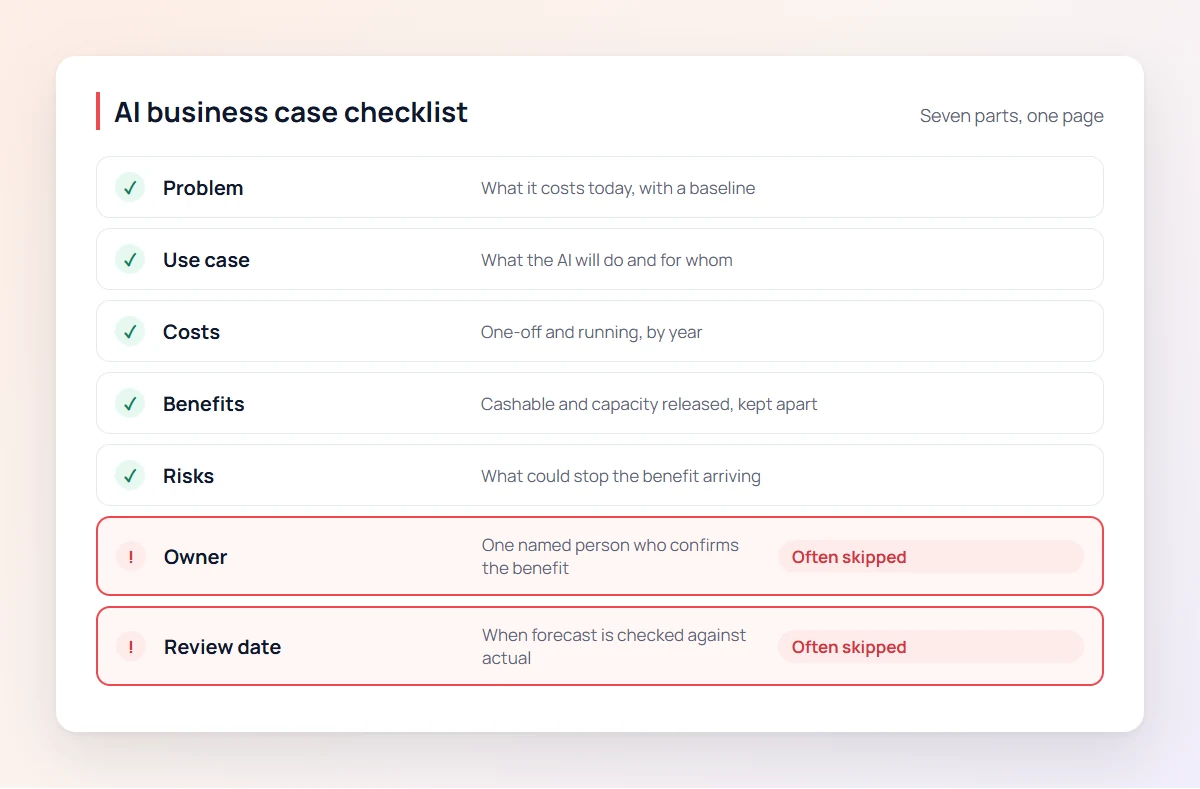
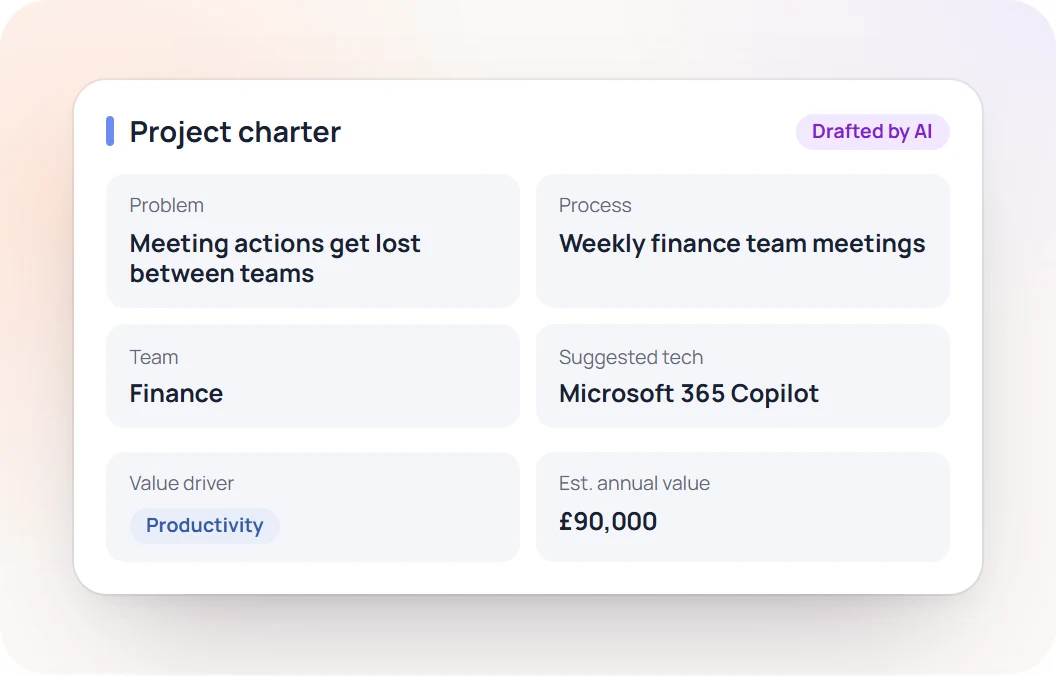
In SilkFlo: every idea has a Business Case tab that holds all seven parts. The problem, value driver and estimated value come from the idea’s assessment. The Business Case tab adds the costs, the timeline, the forecast and, after go-live, the actual results. Owners and review dates sit on the same idea, so nothing lives in a separate document.
How do we decide which AI ideas get funded?
A common version of the problem is “we’ve got more AI ideas than we can handle”. The answer is to judge every idea against the same short list of questions, so the decision is about the idea and not about who argued best.
- Value: how much is the benefit, and how confident are we in the baseline?
- Cost: what is the total cost over three years, not just the licence?
- Effort and risk: how hard is it to deliver, and what could stop it?
- Ownership: is there a named person who will take the benefit?
Two things make this work in practice. First, capture ideas in one place and one format, so you are comparing like with like. Ideas that live in email threads and slide decks cannot be ranked. Second, keep the first pass light. A quick look at value and effort tells you which ideas deserve the work of a full business case, and which can wait.
In SilkFlo: anyone in the organisation can submit an idea in plain words, and AI drafts the starting point: it classifies the value driver and seeds an estimate. There are also 20 ready-made solution templates that prefill an idea with typical costs and benefits. Each idea is then assessed for estimated annual value, hours saved and how easy it is to deliver (easy, medium or difficult). A value-versus-effort view plots every idea, so the high-value, easy ones stand out as quick wins. The full business case then opens for the ideas worth taking forward. See how it works in opportunity discovery.
The payoff for ranking is real. Gartner’s AI value survey of more than 1,300 leaders at organisations with $50m+ revenue found that organisations that constantly track the ROI of their AI initiatives, treat AI as a portfolio of value and regularly reassess and discontinue underperforming projects report positive returns in 81% of their AI initiatives (fielded January to April 2026). Deciding what not to fund, and what to stop, is part of the business case.
How do we show the benefit: value drivers, hard benefits and soft benefits?
A benefit that is not tied to something the organisation cares about is easy to cut. Start by naming the value driver, the reason the initiative exists. SilkFlo uses six:
- Productivity and automation improvement
- Cost reduction
- Revenue growth
- Customer experience and improvement
- Compliance and risk mitigation
- Employee experience and retention
Give each initiative one primary driver. It decides how the benefit is measured: a productivity idea is measured in hours and labour cost, a revenue idea in the uplift on a metric, a customer experience idea in a score such as NPS. Tagging every idea also shows whether the portfolio is balanced or has bet everything on one kind of value.
Then separate the benefits by how hard they are:
- Hard benefits are financial and can be traced to a number in the accounts. Cashable savings make a budget line smaller. Capacity released is time freed up, which only becomes a saving when it is redeployed or avoids a hire, so report it on its own line and never add it to cash.
- Soft benefits are real improvements that do not convert cleanly to pounds, such as customer satisfaction, employee engagement or retention. Do not force a price onto them. Set a target against a named measure, record where you start and check it later.
In SilkFlo: the financial impact is broken down by value driver, with cash and capacity kept apart. Benefits that do not convert to pounds are recorded as strategic targets against a named measure (NPS, CSAT, customer effort score, employee NPS or retention), with a current and a target score, so they are tracked alongside the financial case instead of being left out.
How do we cost an AI initiative the way finance expects?
Finance will ask for both sides of the case, split the way they budget. Show two kinds of cost on separate lines:
- One-off investment (capital expenditure, or capex): what it costs to get the initiative live, such as analysis, design, build, integration, testing and training.
- Running costs (operating expenditure, or opex): what it costs every year to keep it going, such as licences, hosting, model usage and support.
Leave out the running costs and every initiative looks better than it is. Three habits keep the figures honest:
- Cost the people. List who will work on it, their day rate, how many days, and what share of their time this initiative takes.
- Share costs fairly. If a licence or platform serves several initiatives, charge each one its share. Putting the whole bill on one idea sinks its ROI, and leaving it off all of them hides the real cost.
- Count the work that stays. Most automations leave some manual effort behind. Include the cost of what people still do by hand after go-live.
In SilkFlo: the cost side of the Business Case tab has a section for one-off investment and a section for annual running costs. You pick each cost item, such as a role at a day rate or a software licence, and set the quantity and the share of its cost that belongs to this initiative. A line for residual manual effort is added for you. Your admin sets up cost items and rates once and every business case reuses them, so costing a new idea takes minutes and finance sees the same rates every time. Change the scenario, for example fewer seats or a phased rollout, and the case recalculates straight away.
How do we plan the timeline and the people for a business case?
A board that approves the money will ask when the benefit starts and who does the work. Put both in the case:
- A start date and a go-live date. Benefits count from go-live, so even an estimate matters. Payback and results tracking both depend on it.
- Days for each phase. Break the delivery into analysis, design, build and testing, and say how long each takes.
- A check that the plan adds up. Compare the days you planned for each phase with the people you have allocated. A phase with ten days of work and four days of people is the first thing a reviewer will question.
In SilkFlo: you enter the start date, the go-live date and the days for each phase. SilkFlo compares them with the people allocated in the costs and shows each phase as allocated days against capacity, for example 4 of 10 days, so under-resourced phases are obvious before the case is submitted. A Gantt view lays out the phases, and the implementation schedule and resource load appear in the finished case.
How do we build a three-year cost-benefit forecast for an AI use case?
Build it in five steps. Use the same layout for every idea so the board can compare them.
- Set the baseline. Measure the current state before the AI goes in: volume, time per item, cost per item, error rate. Use your own data. No baseline, no benefit you can prove later.
- List the costs by year. One-off costs (build, integration, training) land mostly in year zero and one. Running costs (licences, support, model usage, the team that maintains it) repeat each year.
- List the benefits by year. Apply your method to the baseline. Start with a realistic ramp, because adoption is rarely full on day one. Mark each benefit as cashable or capacity released.
- Show three scenarios. Conservative, expected and optimistic. Boards trust a range more than a single number.
- Calculate the outcome. Net benefit per year, cumulative position, payback period and ROI over three years.
A simple layout:
| Year 0 | Year 1 | Year 2 | Year 3 | |
|---|---|---|---|---|
| One-off costs | build, integration, training | remaining rollout | ||
| Running costs | licences, support | licences, support | licences, support | |
| Cashable benefit | per baseline and method | per baseline and method | per baseline and method | |
| Capacity released | hours, redeployed or avoided hire | hours, redeployed or avoided hire | hours, redeployed or avoided hire | |
| Net position |
Here is the same layout filled in for a document-processing use case in a claims team. Example figures.
| Year 0 | Year 1 | Year 2 | Year 3 | |
|---|---|---|---|---|
| One-off costs | £60,000 | £15,000 | ||
| Running costs | £40,000 | £40,000 | £40,000 | |
| Cashable benefit | £50,000 | £110,000 | £120,000 | |
| Capacity released | 1,500 hours to backlog | 3,000 hours, one hire avoided | 3,000 hours | |
| Net position | -£60,000 | -£5,000 | £70,000 | £80,000 |
| Cumulative | -£60,000 | -£65,000 | £5,000 | £85,000 |
Over three years the case costs £195,000 and returns £280,000 in cashable benefit, an ROI of about 44% on cash alone, with payback in year two. The capacity line is reported separately, so the board can see the extra value without it inflating the cash figure.
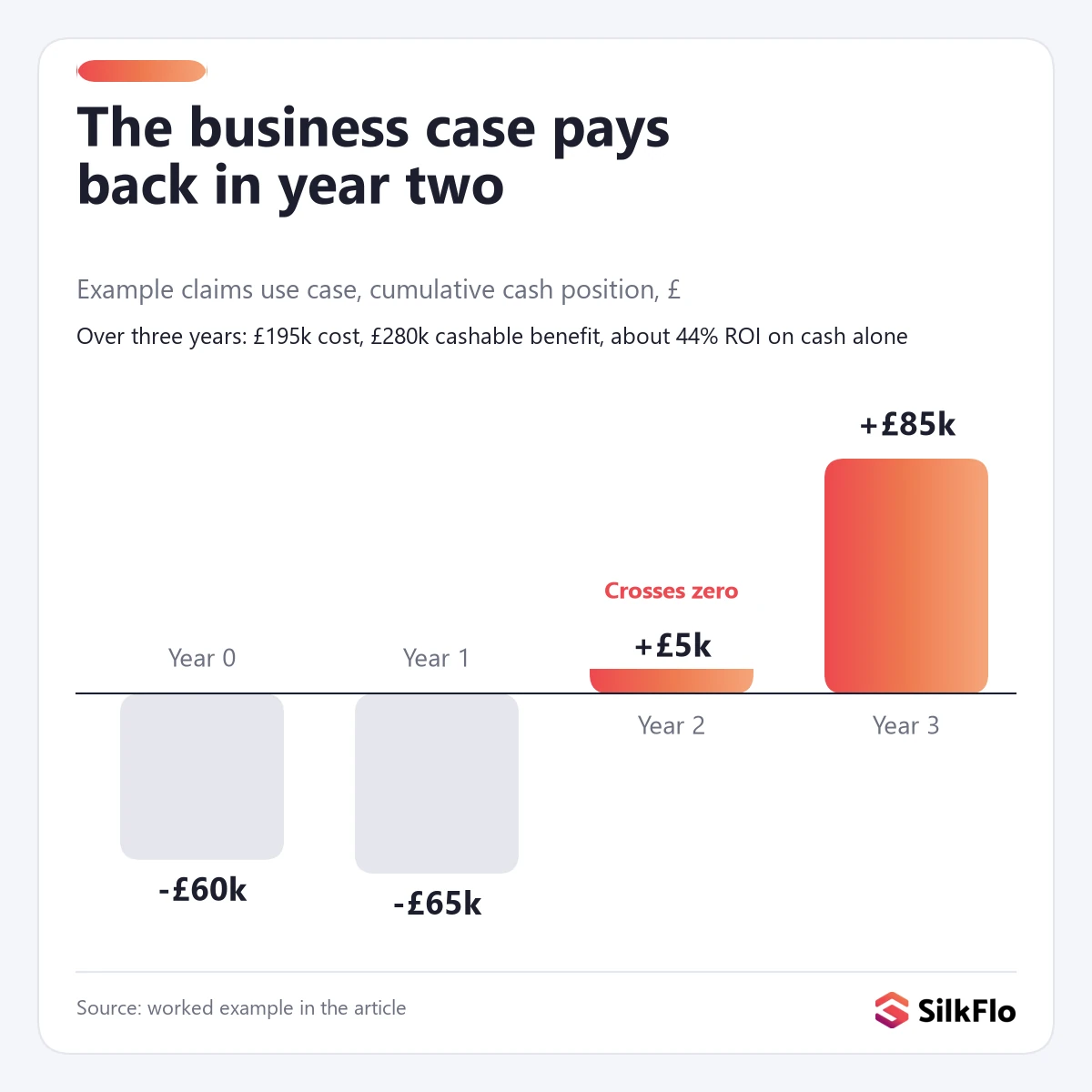
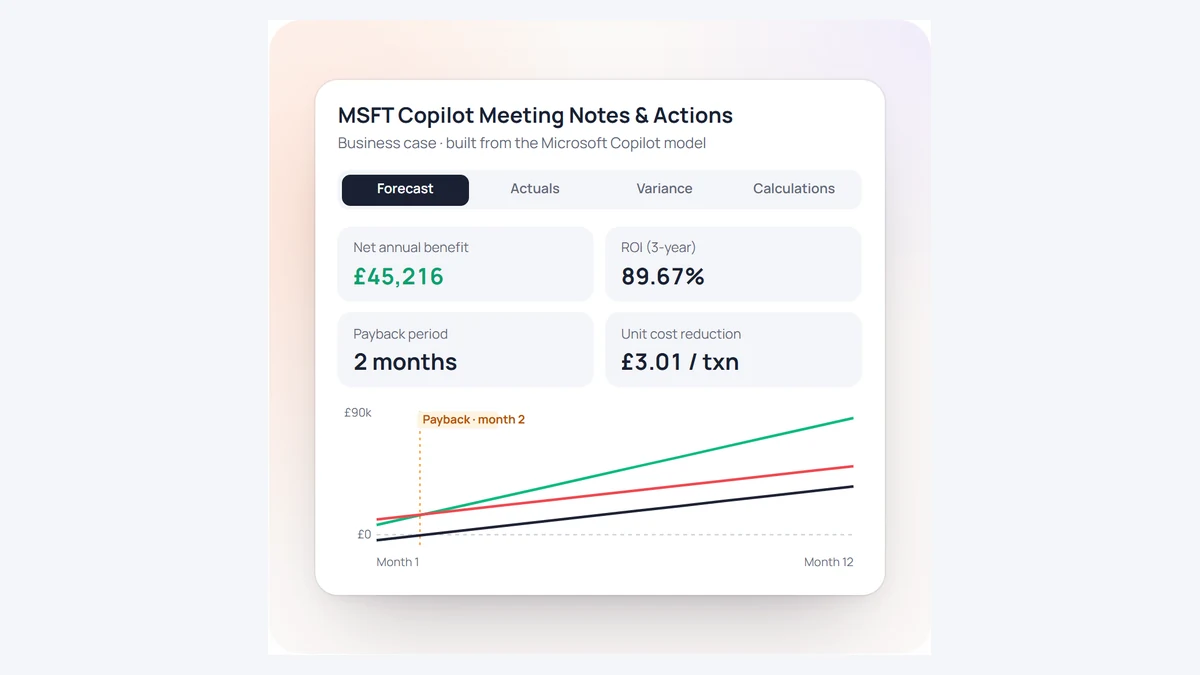
In SilkFlo: the forecast is calculated for you from the costs, benefits and timeline you entered. It shows net annual benefit, three-year ROI and payback period, and plots cumulative spend, cumulative benefit and net cash position so the break-even point is visible. If benefits never exceed running costs, it says so instead of showing a flattering number. Every formula can be inspected, so finance can follow the arithmetic. To test a single number first, the free AI ROI calculator runs the arithmetic for one idea. When you are ready to build out the full business case, SilkFlo’s Business Case Builder makes it easy.
SilkFlo reports 4x faster time-to-value from idea to board-ready business case. Aviva UK’s Claims Innovation team used it to qualify 102 opportunities in 21 days, each with a costed business case, at £865 against £75,600 for a consulting-led approach.
How does an AI lead win the CFO’s backing when the board is risk-focused?
Treat the risk-focused board as a design brief. They are not against AI. They are against spend they cannot explain afterwards.
- Put the downside first. Show the conservative case and what you will lose if it plays out. A board that sees the downside early trusts the upside more.
- Show the stop condition. “If we have not reached this result by this month, we stop or redesign.” This turns an open-ended commitment into a bounded one.
- Use their language. Finance wants cost lines, baselines and variances, not adoption rates. Say what gets smaller in the budget, not how many people logged in.
- Bring finance in early. A study by the Return on AI Institute and Babson College found only 2% of organisations make the CFO responsible for delivering AI value, yet 76% of those that do report a great deal of value.
- Let the budget holder see the case. A summary pasted into a slide goes stale the day it is written. Give the people who hold the budget access to the live case, so they read the same numbers you do.
In SilkFlo: people added to an idea can be given view access to its cost-benefit analysis, so a budget holder or finance partner opens the live case in dashboard view, with the tiles, cash-flow chart and itemised costs, without being able to change it. Only people with edit permission can change the figures.
For a longer view of how finance and operations teams track this, see the finance and operations hub.
How do we check realised value against the original business case forecast, and how often?
Review monthly if you can, and at least quarterly. Quarterly is the minimum because a shortfall found after a year is a year of spend you cannot get back. Keep the approved forecast fixed, and record the actual results beside it rather than editing the forecast to match.
The check has three steps:
- Capture actuals from your own systems. Take the cost and benefit figures from finance and operational data, not from the vendor’s dashboard. Vendor dashboards tend to report adoption, not the effect on the budget.
- Compare with the forecast line by line. Costs, cashable benefit and capacity released, each against what the case said. Note where the difference came from.
- Decide: continue, fix or stop. This is where the stop conditions from the case are used. Record the decision.
Councils show what this looks like in practice. Somerset Council gave 300 Copilot licences to volunteers, calculated an ROI of 4 to 10 times from time saved against a £25 a month licence, and reviews the benefits every three months (Local Government Association case study). Barnsley Council expanded its Copilot pilot from 300 to 2,000 licences after a business case that quantified the benefits, and has committed to proving the ROI within a year (Local Government Association case study). Both put a review into the plan from the start.
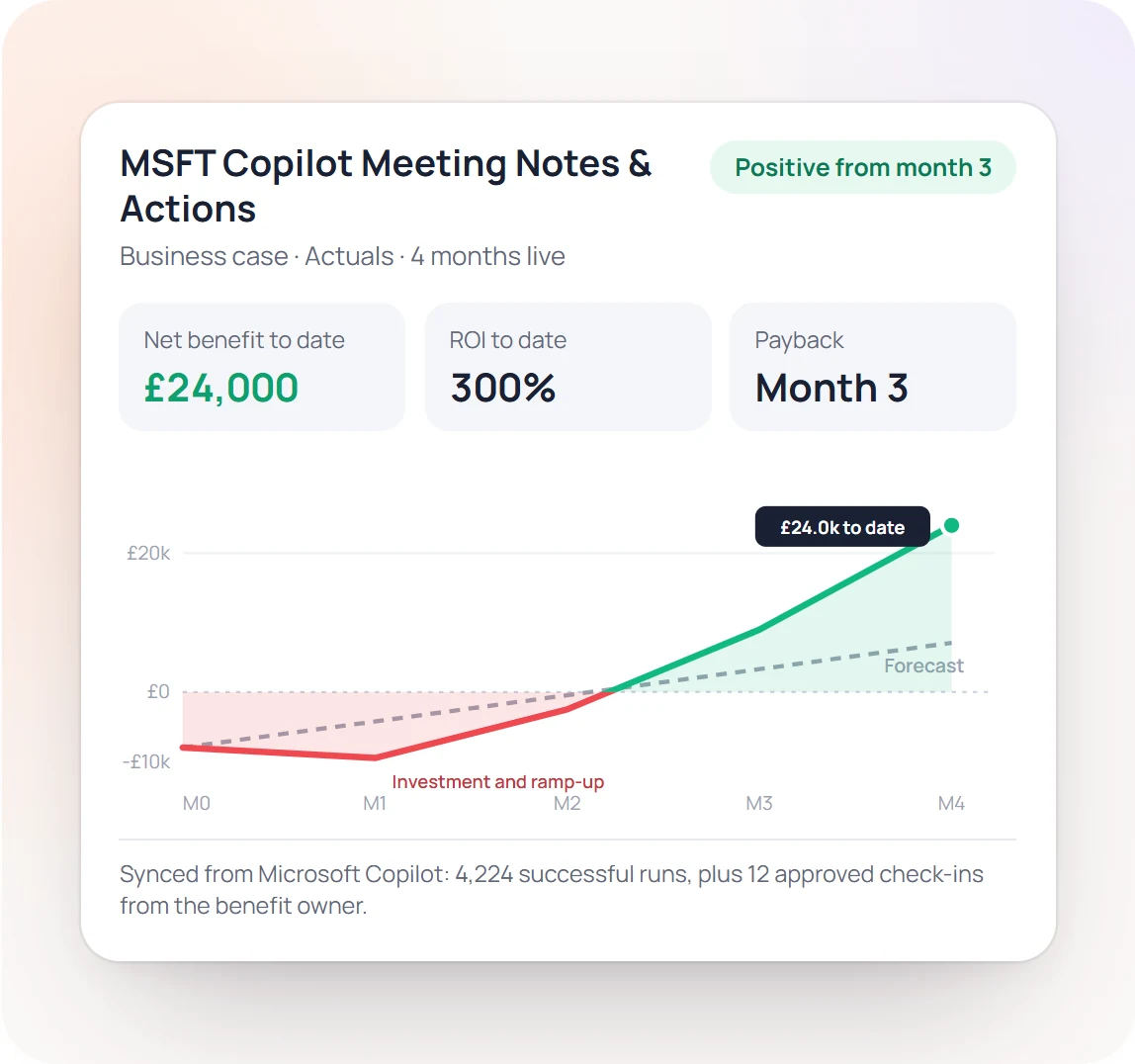
In SilkFlo: once an initiative is live, the Actuals view uses the same layout as the forecast. Benefits can be sent in automatically from your live systems through the SilkFlo API or entered by hand, and actual costs are recorded separately so the forecast stays untouched. A variance view then puts forecast and actual side by side, line by line, with a headline saying how far ahead or behind plan you are. Staffordshire County Council tracks UiPath, Power Automate and Microsoft Copilot in SilkFlo. For the Copilot case in particular, see Copilot ROI. For the wider idea, see what AI value realisation means.
A one-page AI business case template
Use this as the front page of every case. Anything that does not fit goes in an appendix.
| Section | What to write |
|---|---|
| Problem | The process, its volume and its current cost or delay, from your own data |
| Proposed change | The one workflow the AI changes, and the alternatives considered |
| Value drivers | One primary and up to two secondary, such as cost reduction or customer experience |
| Three-year cost | One-off and running costs, including the time of the people who run it |
| Three-year benefit | Cashable and capacity released, each with its method and baseline |
| Scenarios | Conservative, expected and optimistic ROI and payback |
| Risks and stop conditions | What could go wrong, and the result that would make you stop |
| Owner | The person accountable for the benefit |
| Review dates | When actuals will be compared with the forecast, and by whom |
Why AI business cases get rejected
Most rejected cases fail for the same few reasons. Each one has a fix that you can build into the case before it goes to the board:
- No baseline. The benefit is an estimate on top of an estimate, so finance cannot test it. Fix: record the starting figure for every benefit before the change.
- Licence cost only. Integration, training, support and staff time are missing, so the board suspects the real cost is higher. Fix: show one-off and running costs on separate lines, with the people costed.
- Hours counted as cash. Time saved is presented as a saving without saying what it will become. Fix: report cashable savings and capacity released separately.
- No owner. The case names a sponsor for delivery but nobody for the benefit. Fix: name one person accountable for each benefit.
- No way out. There is no stop condition, so approving the case feels like an open-ended commitment. Fix: state the result that triggers a stop or redesign, and the date it will be checked.
- No plan for the people or the dates. The board cannot see who does the work or when the benefit starts. Fix: add a go-live date and check the phases against the people allocated.
Fixing these does more for approval rates than any amount of polish on the forecast.
How to build your first AI business case in SilkFlo
Pick one idea that is already waiting for a decision. In SilkFlo, submit it, let the assessment size the value, then open the Business Case tab to add the costs, the timeline and the owner. The forecast, ROI and payback calculate as you go, and the case is ready to share with the budget holder in dashboard view. When it is live, the same tab tracks the results against the forecast.
When you are ready to build out the full business case, SilkFlo’s Business Case Builder makes it easy. To check where your organisation stands first, take the AI ROI Maturity Assessment.
If you run an AI or automation programme, the innovation and CoE hub covers how to keep every business case and its results in one place. To see it with your own ideas, book a SilkFlo demo.
Frequently Asked Questions
How do you write an AI business case that gets funded?
Our board is mostly risk-focused. How does an AI lead win the CFO’s backing?
Lead with the conservative case and the stop condition, report in finance terms such as cost lines and baselines instead of adoption, and bring the CFO in while the case is being built, not after.
How do we check realised value against the original business case forecast, and how often?
Take actuals from your own finance and operational systems, compare them with the forecast line by line, and decide whether to continue, fix or stop. Do it monthly if possible and at least quarterly.
How do we build a three-year cost-benefit forecast for an AI use case?
Set a baseline from your own data, list one-off and running costs by year, apply a stated method to get benefits by year, split them into cashable and capacity released, and show conservative, expected and optimistic scenarios. Finish with net position, payback and three-year ROI.
We’ve got more AI ideas than we can handle. How do we decide which ones get funded?
Score every idea against the same four questions: value, total cost, effort and risk, and ownership. Rank them, fund from the top, and agree up front which projects you will stop if results fall short.
What should an AI business case include to get through the board?
Seven parts: a measurable problem, a single use case with options, the full three-year cost, benefits with a stated method, risks with stop conditions, a named benefit owner and a review date. The owner and the review date are the parts most cases leave out.