
Benefits realisation management is how an organisation plans, tracks and proves the benefits a project or programme was funded to deliver, from the business case through to the years after go-live. It gives every benefit an owner, a baseline, a measure and a date, then checks actual results against the forecast. Most organisations handle the first half well, but then the benefits fade after go-live, mainly because nobody owns them and nobody keeps the numbers updated.
This guide covers what benefits realisation management (BRM) is, the lifecycle and documents behind it, how to keep benefit owners engaged once a project is live, how to choose value drivers, and how BRM applies to AI and digital spend, where the classic approach most often breaks down.
What is benefits realisation management?
A benefit is a measurable improvement that a stakeholder sees as worthwhile, such as lower cost, faster service or fewer errors. A dis-benefit is a measurable downside that someone sees as negative, such as extra training time or a new licence cost. Benefits realisation management is the discipline that makes sure the benefits arrive, the dis-benefits are known, and someone can prove both.
The practice is well established in UK government. The Government Functional Standard for project delivery (GovS 002) expects benefits to be defined, owned and tracked for government projects, and the HM Treasury Green Book sets the appraisal and evaluation approach that a business case feeds into. The same ideas apply in the private sector, where the question is usually framed as return on investment.
A note on spelling: UK guidance uses “benefits realisation”, and US sources use “benefits realization” or “benefit realization”. They mean the same thing.
BRM is broader than a single project review. It covers a whole portfolio and runs for as long as the benefits do. For AI and automation, the same discipline is often called AI value realisation.
Why benefits stop being tracked after go-live
Most organisations are good at forecasting benefits to win funding and poor at checking them afterwards. Three patterns explain the gap.
- No measures were set. In a survey of 201 UK public sector transformation decision-makers, 78% admitted they had not set key performance indicators for their programmes. Without a measure, there is nothing to track.
- Nobody is accountable. KPMG’s Q2 2026 AI Pulse found that organisations where the CEO is accountable for AI outcomes are far more likely to report established ROI, 14% against 4%. Organisations with full visibility of AI running costs were five times more likely to report established ROI, 15% against 3%.
- The portfolio is never reassessed. Gartner’s survey of more than 1,300 leaders found that organisations that track ROI constantly, manage AI as a portfolio and stop underperforming initiatives reported positive returns on 81% of their AI initiatives.
The lesson across all three is the same. Benefits are realised by organisations that measure, assign owners and act on what the numbers say, not by those that write good business cases.
To see where your organisation stands, the two-minute AI ROI maturity assessment benchmarks how well you track realised value.
How do we track realised benefits once a project is live, not just the forecast?
Keep the forecast and the actual side by side in one register, and update the actual on a schedule. For each benefit, record the baseline before the change, the forecast, the measure and the data source. Then pull the actual result monthly from the system that owns the data (the finance ledger, HR system or case system), not from the project team’s estimate or a vendor dashboard. The gap between forecast and actual is the number that matters, and it should be reported, not buried.
How do we make sure benefit owners actually update the numbers months after go-live?
Make it easy, make it visible and make it someone’s job.
- Name the owner in the business case. The benefit owner sits in the area that gains, not in the project team, and signs off the forecast before funding.
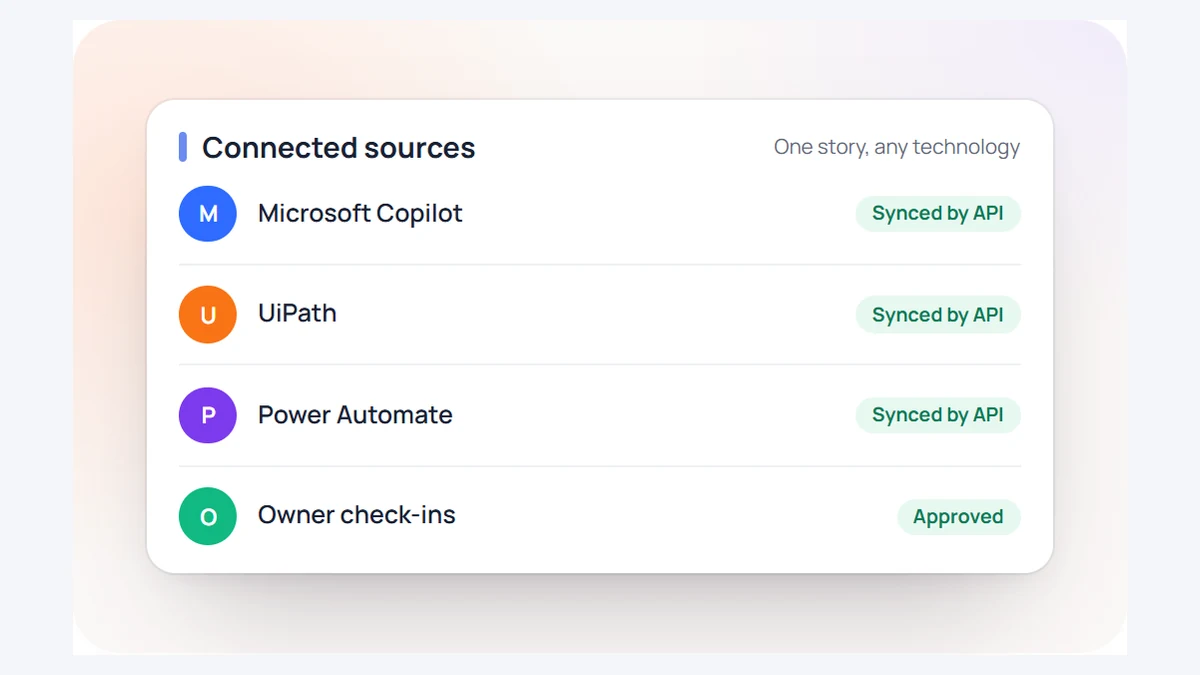
- Automate what you can. If actuals come straight from finance or operational systems, the owner reviews a number rather than hunting for it.
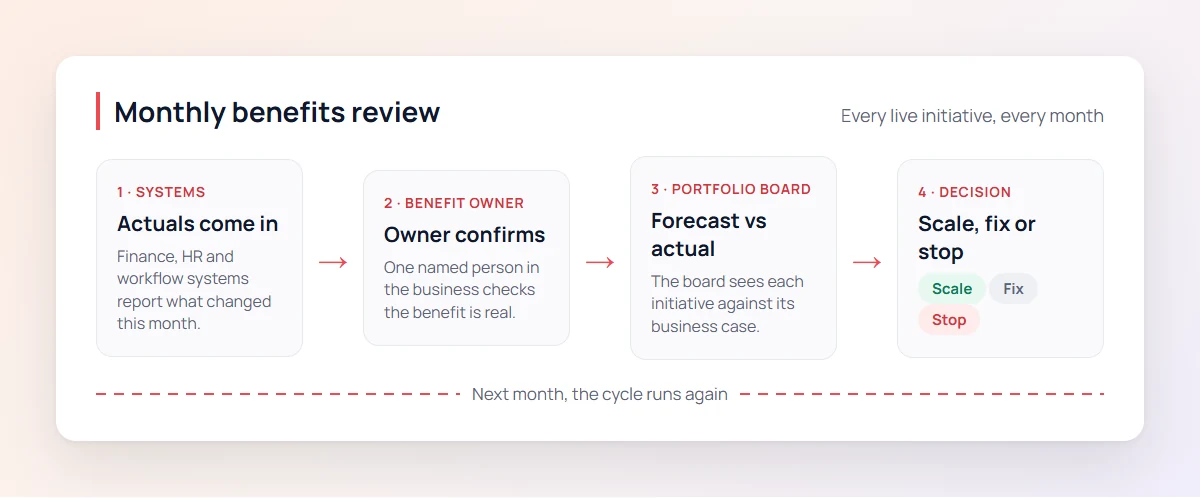
- Put it on a standing agenda. A monthly portfolio review where each owner reports one line is far more reliable than an annual request.
- Ask a short question. “Is this on track, behind or not delivering, and why?” gets answered. A long form does not.
- Show what happens next. When owners see benefits data drive real decisions (more funding, a fix or a stop), they keep it up to date.
The benefits realisation lifecycle
Most frameworks describe the same flow in different words. In plain terms, it has six stages.
| Stage | What happens | Key output |
|---|---|---|
| 1. Identify | Link the investment to objectives and list the benefits and dis-benefits it should produce | Benefits map |
| 2. Plan | Give each benefit an owner, a measure, a target and a timeline | Benefits plan |
| 3. Baseline | Measure each benefit’s starting point before anything changes | Baseline figures |
| 4. Deliver | Build and launch the change, and manage any dis-benefits | Change in place |
| 5. Track | Compare actual results with the forecast on a fixed schedule | Benefits register |
| 6. Review and close | Confirm what was realised, act on gaps and record lessons | Benefits review |
Stages 3 and 5 are where most programmes fail. A missing baseline makes any later claim impossible to prove, and tracking that stops at go-live leaves the benefits unaccounted for.
Benefits map
A benefits map links each investment to the objectives it serves. It runs from the change (for example, automating invoice matching) to the immediate benefit (less manual matching), to the intermediate benefit (faster month-end close), to the objective (lower finance operating cost). Mapping it out shows which benefits are real outcomes and which are steps on the way.
Benefits plan
The benefits plan sets out how and when each benefit will be delivered and measured. Write it alongside the business case, before delivery starts. For each benefit it records:
- the owner
- the measure and the data source
- the baseline and the target
- the date the benefit should start and when it should reach the target
- dependencies, such as process changes or training
- known dis-benefits
A business case with these fields built in is far easier to track later. The Business Case Builder captures them at the point an idea is costed.
Benefits register
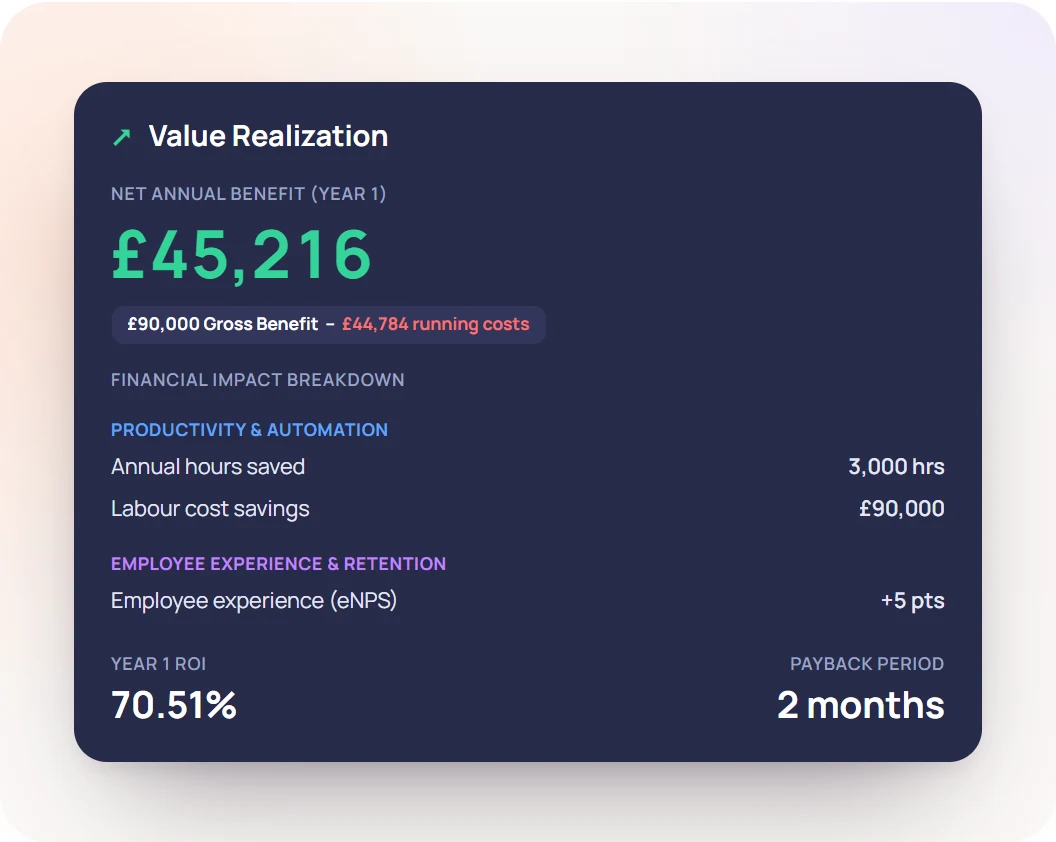
The benefits register is the working record of every benefit across the portfolio, updated regularly. A practical template:
| Field | What goes in it |
|---|---|
| Benefit | A short description, for example “reduce agency spend in revenues” |
| Initiative | The project or AI tool that delivers it |
| Value driver | Cost reduction, productivity, revenue, customer experience, compliance and risk, or employee experience |
| Type | Cashable, non-cashable or cost avoidance |
| Owner | The named person accountable for the benefit |
| Measure and source | What is measured, and the system it comes from |
| Baseline | The figure before the change |
| Forecast | The target, with a date |
| Actual to date | The latest measured figure |
| Variance | Actual minus forecast |
| Status | On track, behind or not delivering |
| Next review | When it is looked at again |
Update it monthly. The total variance across the register is the single figure a board or finance committee needs.
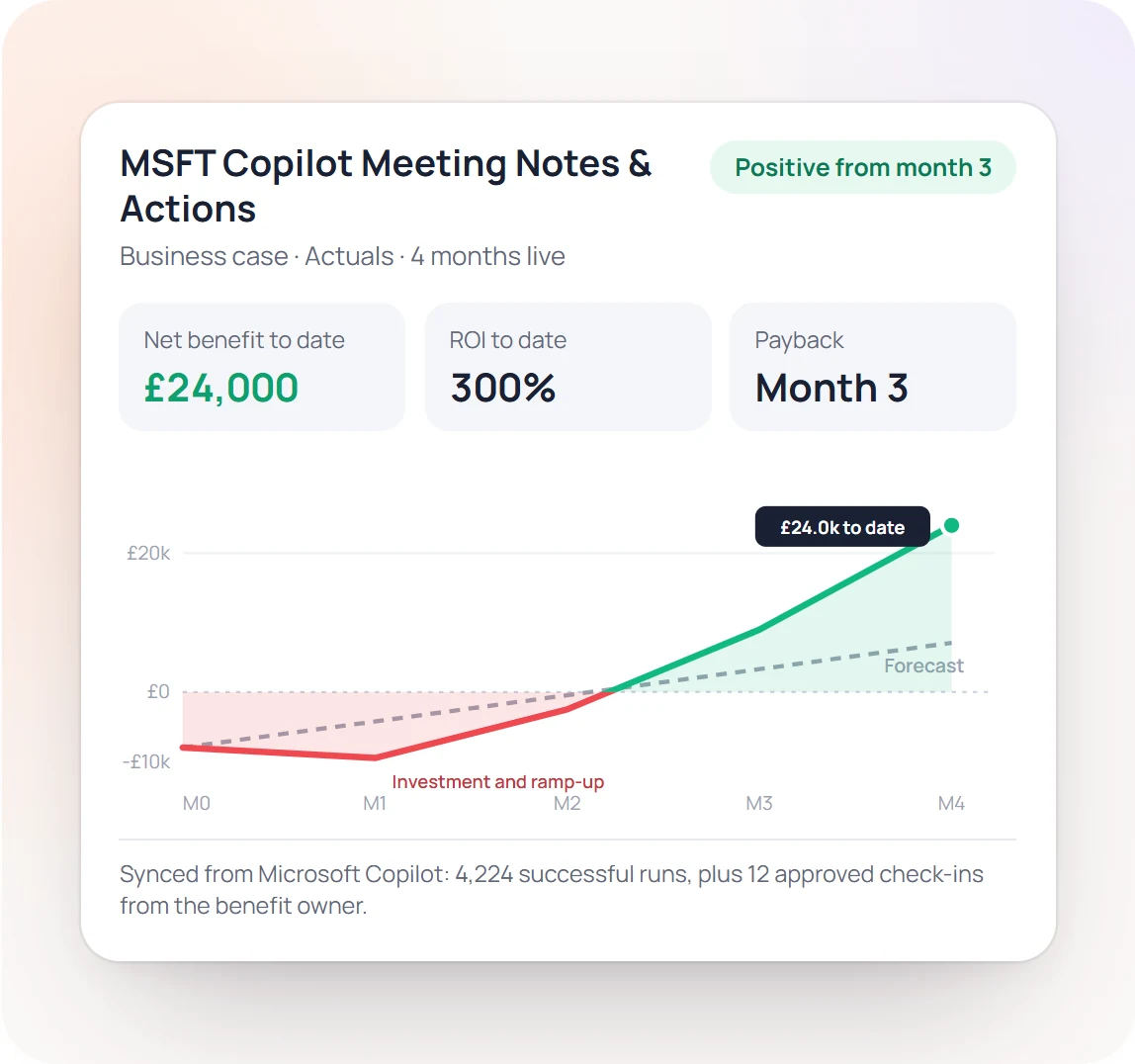
Benefits review
A benefits review checks, after go-live, whether a project delivered what its business case promised, and decides what happens next: continue, fix, scale or stop. A first check three to six months after go-live, followed by regular reviews, catches problems while they can still be fixed. Our guide to the post-implementation benefits review covers how to run one.
Types of benefit
Not every benefit is cash, and treating them all as cash is the fastest way to lose credibility with finance.
| Type | What it means | Example | How to evidence it |
|---|---|---|---|
| Cashable | A budget line goes down | Agency spend falls, a contract is cancelled | Ledger figures before and after |
| Cost avoidance | Spending that would have happened no longer does | A planned hire is not needed | The approved plan, and the demand absorbed without it |
| Non-cashable | The same resources deliver more or better | More cases handled by the same team | Volume or quality measures, plus a unit cost |
| Quality | Fewer errors, faster service, better outcomes | Error rate halves | Operational data |
| Risk reduction | Lower likelihood or impact of a problem | Fewer compliance breaches | Incident and audit records |
| Dis-benefit | A measurable downside | Extra training time, a new licence | Cost and time records |
Report each type on its own line. A single headline that adds cash to capacity is the first thing an auditor or finance director will pull apart.
How do we pick and rank the value drivers each initiative is accountable for?
Value drivers are the categories of benefit an initiative is expected to deliver. A practical set for AI and automation has six:
- Productivity and automation improvement
- Cost reduction
- Revenue growth
- Customer experience and improvement
- Compliance and risk mitigation
- Employee experience and retention
Give each initiative one primary driver and at most two secondary ones. Rank them by three questions:
- Size: how much value could this driver plausibly produce?
- Confidence: how sure are we, based on evidence rather than vendor claims?
- Measurability: can we measure it from our own data without a new project?
A driver that scores high on size but low on measurability belongs in the business case as a secondary benefit, not as the headline the initiative is judged on. Tagging every initiative with its drivers also shows where the portfolio is creating value overall.
Benefits realisation for AI and digital spend
Classic BRM was built for projects with a clear end state: a new building, a system replacement, a reorganisation. AI breaks it in three ways.
- Benefits arrive as capacity, not cash. Copilot saves ten minutes here and there across thousands of people. Unless someone decides what that time becomes, it disappears into the working day.
- Usage gets mistaken for value. Vendor dashboards report active users and estimated hours saved. Those are adoption measures, not benefits.
- The tools keep changing. AI agents and automations are edited, extended and retrained after go-live, so the benefits plan needs updating too.
The fix is the same lifecycle, applied more often. Name what freed capacity should become in the business case (lower cost, avoided hires, more output or better quality), measure that outcome from your own data, and review it monthly. Our step-by-step guide to how to measure AI ROI covers the metrics in detail, and the free AI ROI calculator turns costs and expected benefits into return and payback before an initiative is approved.
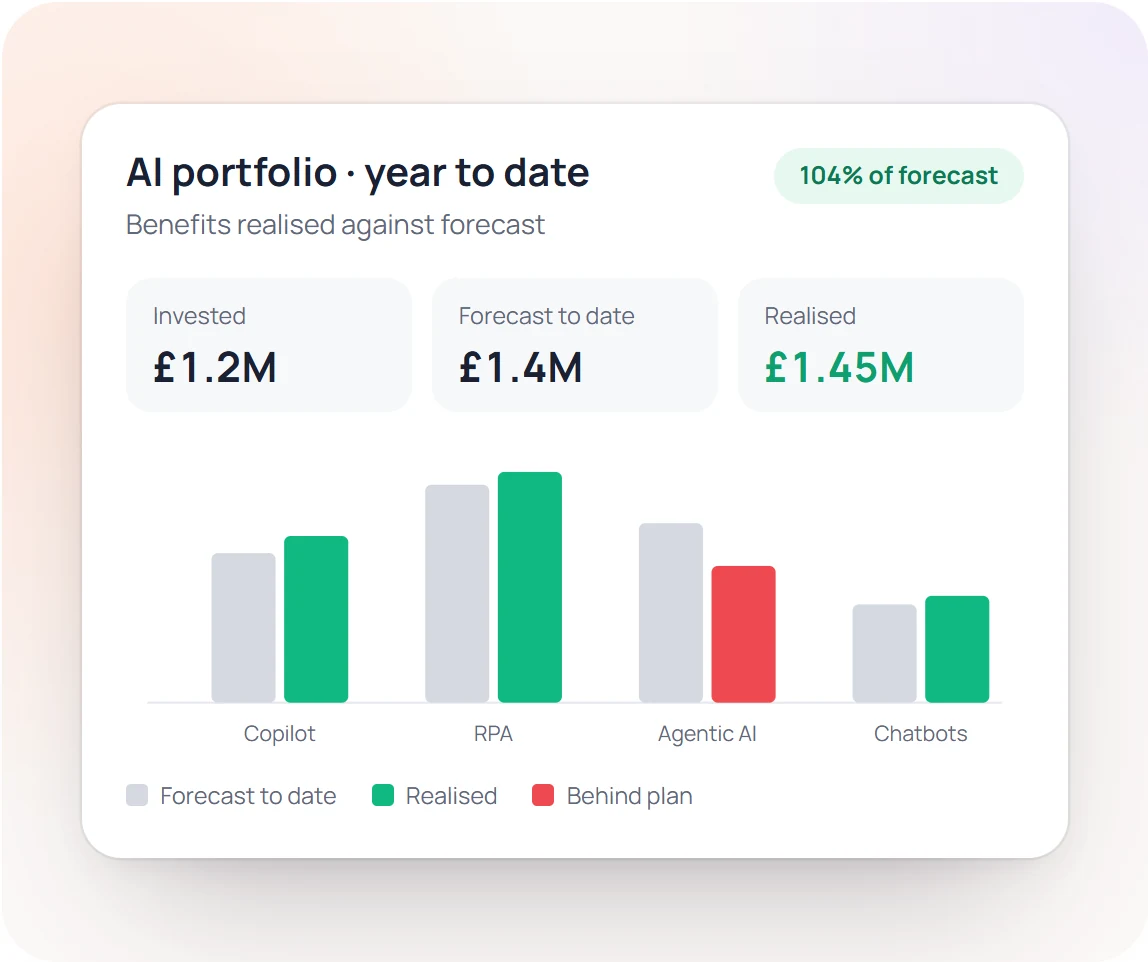
From idea to proven value: where benefits realisation really starts
The lifecycle above begins at “identify”, but for AI and automation the real starting point is earlier. Ideas arrive from across the organisation, and the ones that get funded set the benefits you will later be asked to prove. It helps to treat the whole path as one process, from the first idea to the board report.
- Capture. Collect every idea in one place and one format, so ideas can be compared like for like rather than judged on who argued best.
- Prioritise. Score each idea against the same short list of questions: value, total cost, effort and risk, and whether someone will own the benefit. Fund from the top of the ranking.
- Assess. For the ideas that make the shortlist, check data access, feasibility, complexity and risk before money is committed. Our five-stage guide to identifying and prioritising high-impact AI projects covers this step in detail.
- Build the business case. Cost the idea fully, set out each benefit with its method and baseline, and name the owner and the review date. This is the benefits plan described above, and the Business Case Builder captures it at the point an idea is costed.
- Approve. Decide on the case, including the result that would make you stop or redesign.
- Track and report. Compare actuals with the forecast every month and report the variance to the board. These are stages 5 and 6 of the lifecycle above.
What you do at the start decides what you can prove at the end. An idea that was never scored against the alternatives, or approved without a baseline and an owner, is the hardest benefit to track later. Get the front of the process right and the monthly review becomes a short comparison rather than an investigation.
Benefits realisation in the public sector
Public bodies have an extra reason to get this right: they have to show value for money with public funds. That means evidence for economy, efficiency and effectiveness from the organisation’s own data, and a clear split between cashable savings and freed capacity. Our guide to value for money in local government shows how to build that evidence for AI spend, and the AI ROI framework for local councils covers counting freed officer time.
On the buying side, SilkFlo is listed on G-Cloud 15 (Lot 2b, software as a service), so public sector organisations can buy it through the framework without a full tender.
When does the clock start?
Start it at business case sign-off or at go-live, never at contract signature. Contract signature measures procurement, which can be months before anything reaches users. Starting at sign-off makes the business case accountable from the day money is committed; starting at go-live gives a fair test of the solution itself. Pick one per initiative, write it into the benefits plan and do not move it later.
When benefits go wrong after go-live
Two problems come up in almost every programme: savings that get cut from the delivering team’s budget, and benefits that are still missing months after go-live. The fix for the first is a benefits treatment policy agreed in the business case, setting how much of each cashable saving goes back to the centre and how much the team can reinvest. The fix for the second is a recovery plan: check the measure, find the blocker, re-plan the benefit with its owner and report the variance openly. Our guide to the post-implementation benefits review covers both in detail.
We’ve deployed AI use cases across many brands. How do we collect the data to report the benefits?
Standardise the record, not the systems. Each brand or business unit will run different tools and finance systems, so trying to make them identical stalls the work. Instead:
- Agree one benefits template with the same fields, value drivers and benefit types for every brand.
- Name a benefit owner per brand who submits one figure per benefit each month.
- Pull from source where you can. Where a brand’s finance or operational system can send actuals automatically, connect it once and stop asking for spreadsheets.
- Use shared unit costs. Agree standard hourly rates and activity costs centrally, so freed time is valued the same way everywhere.
- Roll up, then drill down. Report the group total first, with each brand’s line behind it.
If a supplier writes our board paper, who decides the benefits we’re judged on?
You do. A supplier can draft the business case, but the benefits, baselines and targets must be owned and signed off by the organisation that will be held to them. Supplier-written cases tend to lean on the vendor’s own metrics, such as usage and estimated hours saved, which rarely match what finance will later measure. Before the paper goes to the board, check three things: each benefit has an internal owner, each baseline comes from your own data, and each measure is one your finance team already tracks.
How do we record an avoided SLA penalty as a benefit when most penalties are one-off?
Record it as cost avoidance, on its own line, with the evidence behind it. Show the contractual penalty, the history of breaches before the change (for example, how often the service level was missed over the previous year) and the breach record since. Value the benefit at the penalties that would have been expected on the old breach rate, not the maximum possible penalty. Because penalties are lumpy, review the figure over twelve months rather than claiming it month by month.
Common mistakes
- No baseline. The improvement cannot be proved without a starting point.
- Owners in the project team. Project teams move on. Benefit owners need to stay with the benefit.
- Counting hours as cash. Freed time only becomes a saving when something changes.
- Annual reviews only. By the time a yearly review spots a shortfall, it has run for a year.
- Vendor data as evidence. It shows use, not value.
- Ignoring dis-benefits. Leaving out running costs and extra effort overstates the return.
A benefits realisation maturity checklist
Score one point for each statement that is true today.
- Every funded initiative has a business case with forecast benefits.
- Every benefit has a named owner outside the project team.
- Baselines are measured before any change goes live.
- Benefits are classified as cashable, non-cashable or cost avoidance.
- Actuals come from finance or operational systems, not estimates.
- There is one benefits register for the whole portfolio.
- The register is updated at least monthly.
- Variances are reported to a board or committee on a fixed schedule.
- Underperforming initiatives are fixed or stopped based on the data.
- Dis-benefits and running costs are included.
A score of 8 or more means benefits realisation is working. Between 4 and 7, the forecast is strong but tracking is weak. Below 4, benefits are mostly assumed rather than realised.
How SilkFlo helps
SilkFlo is benefits realisation software for AI and automation: the AI Value Realization Platform. It holds every initiative in one portfolio, from idea to costed business case, through approval stages, to benefits tracked against the forecast after go-live. Each benefit carries its owner, value driver and type, with cashable savings kept apart from freed capacity. Actuals are pushed in live from your own systems through the SilkFlo API, so the register updates itself rather than relying on owners to chase numbers, and every change is logged.
It is used by finance and operations teams who need to see what spend is returning against forecast, and by AI centres of excellence that need to evidence value across the portfolio. Staffordshire County Council uses SilkFlo to track UiPath, Power Automate and Microsoft Copilot in one place, and Aviva UK’s Claims Innovation team used it to qualify 102 AI and automation opportunities, worth £12M in savings opportunities, in 21 days, each with a costed business case. Microsoft’s and UiPath’s own dashboards each report usage of their own product; SilkFlo puts every vendor’s results against the business case in one register. Pricing is per admin, and everyone who submits ideas or updates joins free, and public sector buyers can purchase through G-Cloud 15. To see it with your own initiatives, book a SilkFlo demo.
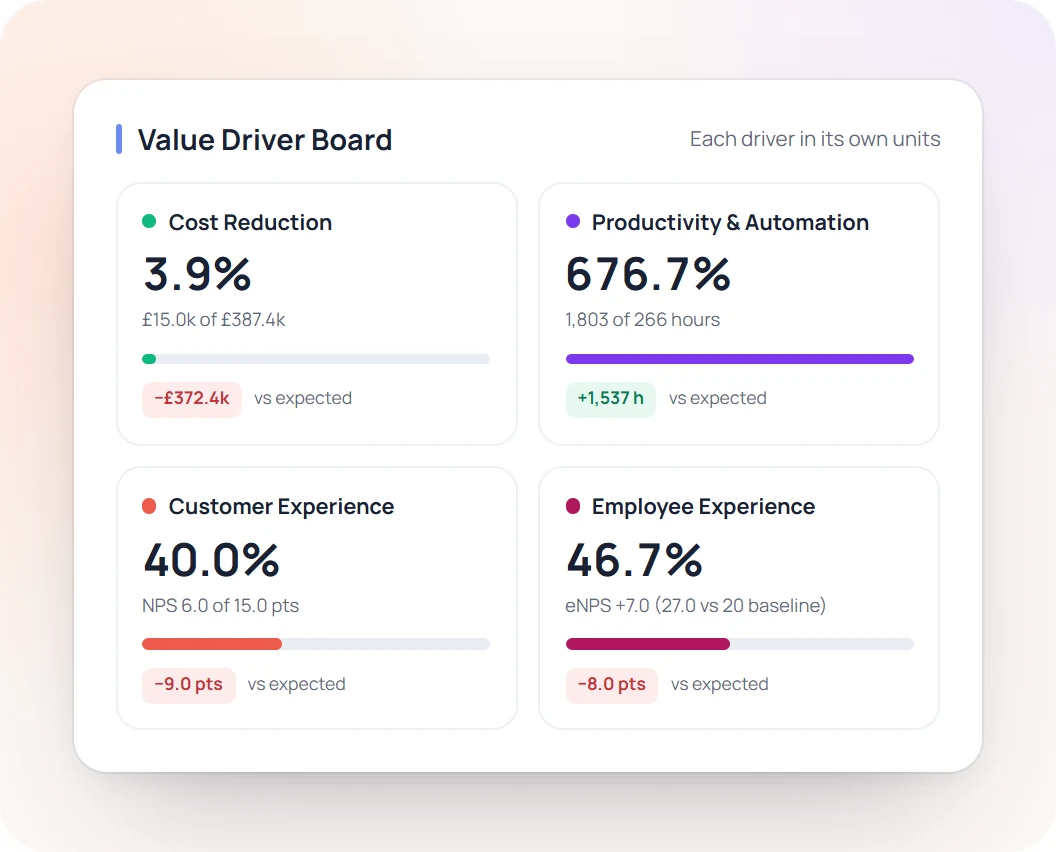
Frequently Asked Questions
What is benefits realisation management?
What is the difference between a benefits plan and a benefits register?
The benefits plan is written with the business case, before delivery starts, and sets out how and when each benefit will be delivered and measured. The benefits register is the working record of every benefit across the portfolio, updated monthly with actuals and the variance against forecast.
What is a dis-benefit?
A measurable downside of a change that someone sees as negative, such as extra training time or a new licence cost. Record dis-benefits in the benefits plan and register. Leaving them out overstates the return.
How soon after go-live should benefits be reviewed?
Run a first check three to six months after go-live, then review regularly, with the benefits register updated monthly. That catches problems while they can still be fixed. An annual review only spots a shortfall after it has run for a year.
Does freed staff time count as a cashable saving?
Only when something changes, such as a budget line going down or a planned hire not being needed. Otherwise it is a non-cashable benefit: the same people deliver more or better. Report it on its own line, never added to cash.