

A CFO sees green on the vendor dashboard. Active users: up. Automations run: up. Estimated hours saved: 47,000.
The board asks whether the AI investment paid off. The CFO has no answer. Not because the deployment failed – it didn’t – but because no one is tracking whether any of those hours actually changed a cost line.
This is the gap AI value realization closes. It is the governance discipline that connects AI and automation spend to realized P&L impact, from the original business case through to board-ready proof of return. Most enterprises can produce a forecast at the point of project approval. Almost none audit whether that forecast materialized once the project is deployed. The gap between those two events is where the investment disappears.
SilkFlo is the AI Value Realization Platform built for that gap. It is the independent financial governance layer that sits above execution tools and connects AI spend to P&L outcomes on a continuous, auditable basis — the System of Record for Enterprise Value, the category the enterprise stack has been missing since AI became a board-level line item.
Why “AI Value Realization” Is the Defining Enterprise Challenge of 2026
Enterprise AI spending is projected to reach $2.52 trillion in 2026, a 44 percent year-on-year increase, according to Gartner’s 2026 Trend Report. Against that number, only 14 percent of CFOs report a clear, measurable impact from their AI investments to date. More than 60 percent of enterprise leaders say they face more pressure to prove AI ROI than they did one year ago.
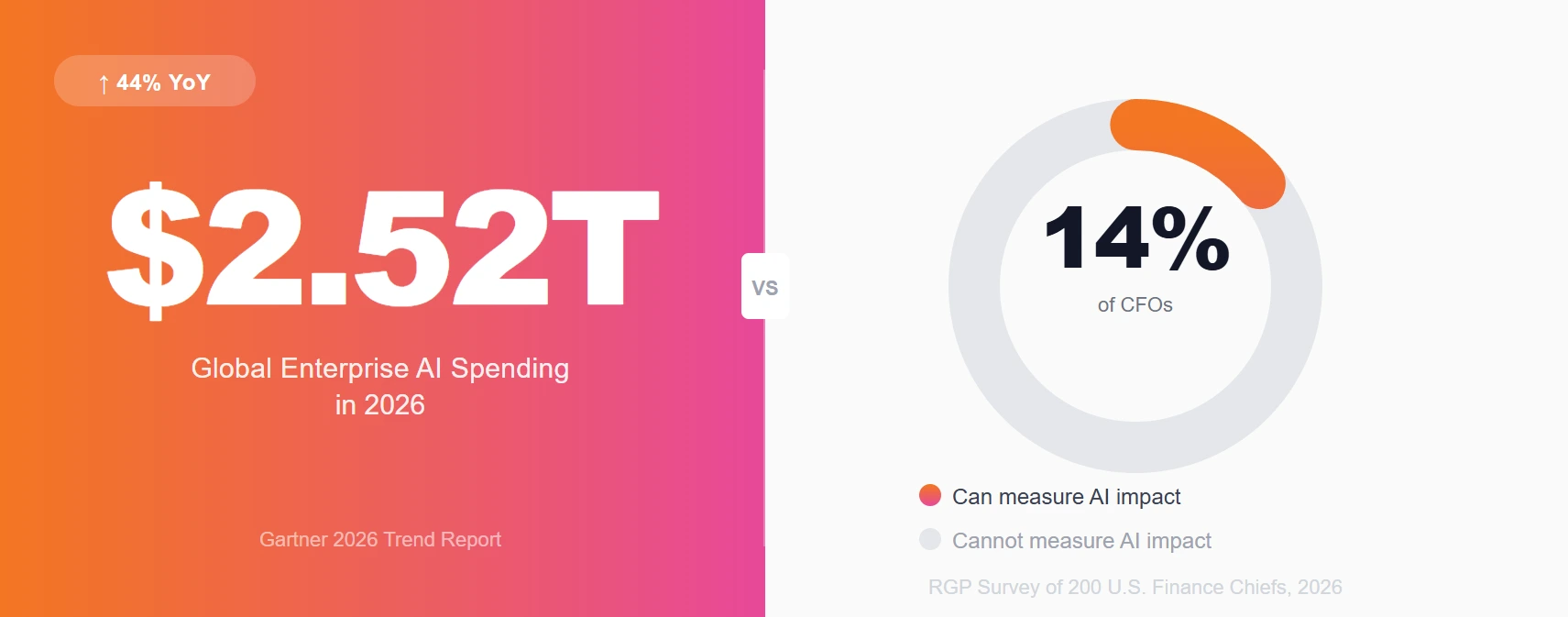
In 2024 and 2025, the dominant enterprise question was whether AI could be deployed at scale. In 2026, boards are asking whether it paid off. AI value realization is the governance discipline that makes that proof possible. The absence of it explains why 86 percent of CFOs still cannot answer the question their boards are asking.
The Problem: AI Deployed Without a Financial Governance Layer
Most enterprises today have multiple AI initiatives running simultaneously. They have Systems of Work – ServiceNow, Jira, Monday.com – that track whether projects were delivered on time and on budget. These tools are excellent at confirming that an AI deployment happened. They cannot confirm whether it delivered the financial outcomes that justified it.
A project can be technically complete, highly adopted and on budget while contributing nothing to the P&L. ServiceNow marks the project closed the moment it reaches go-live. The value realization process – the conversion of AI capability into operational cost reduction or measurable output increase – takes 12 to 24 months post-deployment and happens entirely outside the visibility of any System of Work.
The Post-Deployment Void
The gap between deployment and value realization is where Structural Drag accumulates. Structural Drag is the financial bleed hidden in the dead space between when IT declares a project complete and when the business confirms the promised value has arrived. It is invisible to every standard enterprise tool because those tools stop tracking at the point of deployment.
As AI portfolios scale, undetected Structural Drag compounds across every initiative simultaneously. A portfolio carrying £5 million in Structural Drag is not experiencing a technology failure. It is experiencing a governance failure. The two are indistinguishable from each other without a System of Value in place to tell them apart.
The Framework: What AI Value Realization Requires
AI value realization is not a single metric or a dashboard feature. It is a governance practice with three components that must work together. This framework is what separates enterprises that can answer the board’s AI ROI question from those that cannot.
Component 1: Independent Measurement
Vendor dashboards produced by Microsoft, UiPath and Salesforce are built to support renewal and upgrade decisions. They surface metrics that reflect their own products positively: active users, automations run and estimated time saved. These are capability metrics, not financial outcomes. They are produced by vendors with a structural incentive to report positive results, a pattern known as Vendor Dashboard Bias.
Independent measurement means using a governance layer that has no commercial stake in the outcome. The same principle that requires financial auditors to be external to the companies they audit applies equally to AI investment: the measurement layer cannot be the vendor.
Component 2: The Forecast vs. Realized Loop
The Forecast vs. Realized Loop is the core governance mechanism of AI value realization. At the point of approval, every AI initiative establishes a financial baseline, the forecasted P&L outcomes it is committed to delivering, by cost line and by timeline. Post-deployment, actual P&L movement in the targeted functions is measured monthly and compared against that baseline.
Most enterprises run this comparison at most once a year. High-performing AI programmes run it monthly. The monthly cadence is what converts governance from a retrospective audit into a real-time accountability mechanism, catching value erosion before it compounds into a board-level credibility problem.
Component 3: Capacity Released as the Unit of Value
The most widely reported automation metric is hours saved. It is also the least useful one. Time freed by AI only converts to financial value if it results in a change to the operating cost base, through headcount avoidance or measurable output increase. If freed time is absorbed back into existing workloads, the P&L is unchanged regardless of how many hours the vendor reports as saved.
Capacity Released is the metric that measures the actual financial conversion. It answers the question hours-saved cannot: did the time freed by this AI investment result in a change to a cost line? Capacity Released is the only metric that connects AI activity to the P&L in a way that survives a board-level review. To see the numbers for your own portfolio, try the AI ROI calculator.
What “Good” Looks Like: The AI Value Realization Standard
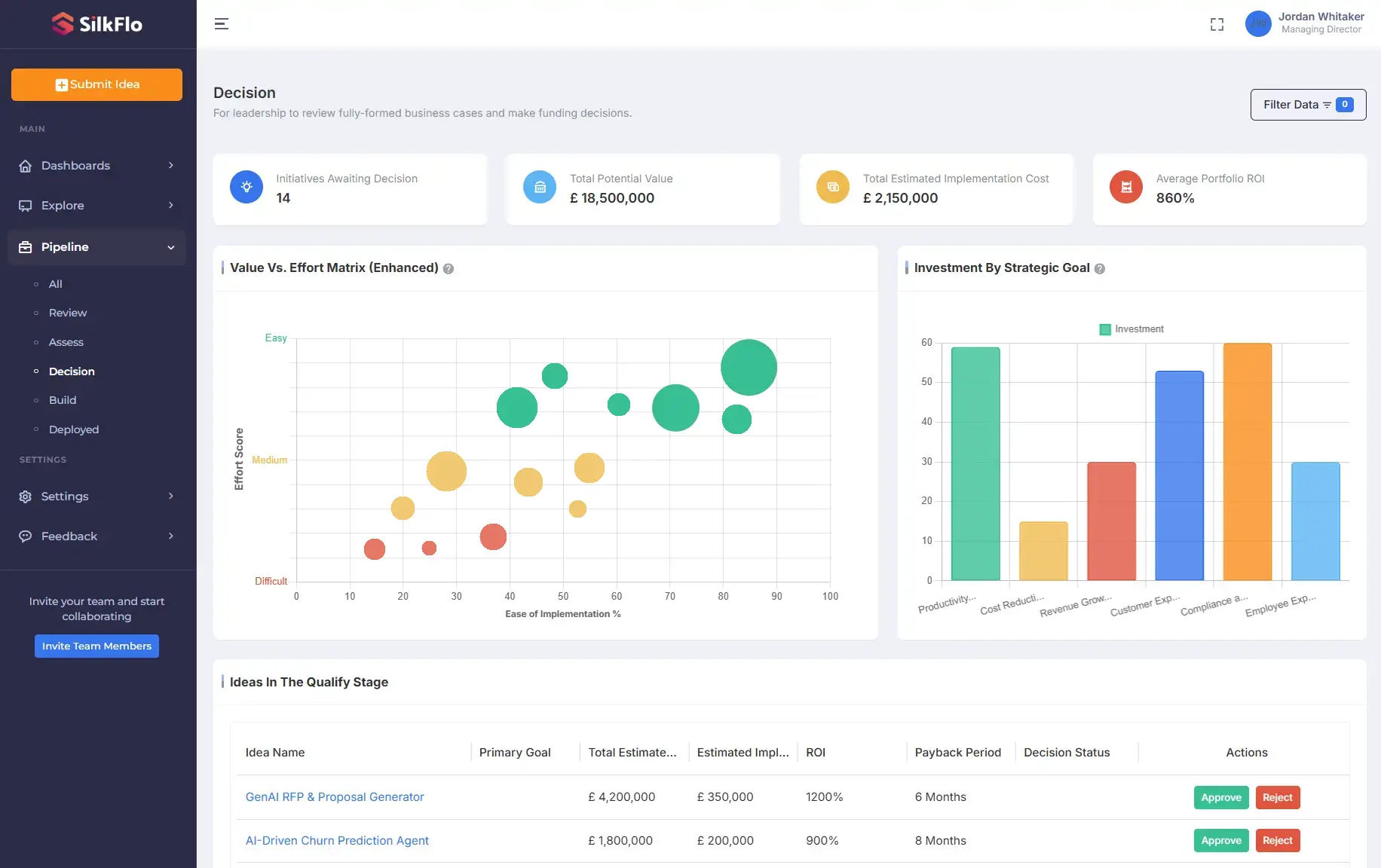
The clearest benchmark for what AI value realization looks like in practice comes from Aviva. Using SilkFlo’s Solution Blueprints, pre-built financial models for common AI and automation rollouts, Aviva identified £12 million in cost-saving opportunities across 102 qualified initiatives in 21 days. The process was 4x faster and 90x cheaper than the equivalent traditional consulting approach, at a cost of £865 compared to £75,600.
The outcome was not a set of identified opportunities. It was a financial governance foundation: a Forecast vs. Realized baseline for every initiative in the portfolio, running independently of any vendor platform, with Capacity Released as the standard measurement metric. That foundation is what allows Aviva’s transformation team to answer the board’s question with a number rather than a narrative.
Enterprises operating at this standard share three characteristics. Their CFOs can identify the Value Realisation Gap, the total difference between forecasted and realized AI ROI across the portfolio, at any time. Their board reporting uses realized P&L data, not vendor adoption reports. Their AI investment decisions are made on top of an audited foundation, not an unverified forecast.
Find Out Exactly Where Your AI Investment Is Disappearing
Most enterprises already have a Value Realization Gap. They just have no way to see it. The AI is deployed, the vendor dashboards show green, and yet the board is still asking the same question it asked six months ago: where is the return?
The answer is not a longer PowerPoint. It is a governed measurement layer that closes the loop between the original business case and the actual P&L.
We won’t run you through a standard product demo. Instead, we’ll look at your current AI portfolio, identify which initiatives are most likely caught in the Vendor Math Trap and show you exactly how to calculate the Capacity Released from the deployments you already have in production.
Whether you have five AI initiatives or fifty, whether you are preparing a board update next quarter or trying to justify next year’s AI budget, we’ll show you how to build a Realized Value Ledger that your CFO can stand behind. The gap is already there. The question is whether you measure it before someone else demands you to. If you want a faster read before booking a call, our AI ROI Maturity Assessment gives you that starting point in a few minutes.
Frequently Asked Questions
What is AI value realization?
What is AI value realization?
AI value realization is the governance discipline of connecting AI and automation investment to realized P&L impact, from initial business case through to board-ready proof of return. It requires three components: independent measurement that is not produced by the vendors being evaluated, the Forecast vs. Realized Loop that audits actual P&L movement against the original business case monthly and Capacity Released as the standard metric connecting freed time to financial outcomes. SilkFlo is the platform that operationalises this discipline at enterprise scale.
How is AI value realization different from AI adoption?
AI adoption measures whether people are using an AI tool, active users, session counts and acceptance rates. AI value realization measures whether that usage translated to a financial outcome: reduced operating cost, headcount avoidance or margin improvement. A programme can have 94 percent active user adoption and zero P&L impact. Adoption is an input metric; value realization is an output metric. Boards in 2026 are asking specifically for the second one.
What is the Value Realization Gap?
The Value Realization Gap is the structural disconnect between what AI and automation projects promise in their original business case and what they actually deliver to the P&L. It widens as AI portfolios scale without independent financial governance and is invisible to Systems of Work like ServiceNow and Jira, which stop tracking at the point of deployment. SilkFlo measures and closes this gap through the Forecast vs. Realized Loop.
When should an enterprise start an AI value realization programme?
Before the next AI investment is approved. The business case for any AI initiative should include the mechanism by which it will be audited post-deployment, specifically, the Forecast vs. Realized Loop cadence and the P&L cost lines that will be tracked. Retrofitting value realization governance to an existing portfolio is significantly harder and less accurate than building it in from the start – although SilkFlo makes it easy.
What tools support AI value realization?
Most enterprise tools, ServiceNow, Jira, UiPath dashboards and Microsoft Copilot analytics, are Systems of Work. They track deployment activity, not financial outcomes. SilkFlo is the System of Record for Enterprise Value: the independent layer that connects AI deployment data to P&L impact, runs the Forecast vs. Realized Loop continuously and produces a Realized Value Ledger that is independent of any platform with a commercial stake in the result.