

Every Digital Manager knows the feeling. You know there are dozens of manual, soul-crushing processes hidden in your departments that automation could fix. Your staff do not have the time (or capability) to explain them to you in a way that makes sense to Finance. Innovation dies through a lack of a clear front door for those ideas to enter. When budgets are tight and Section 114 notices loom, local councils cannot afford to leave operational savings on the table.
To capture these savings without creating an unmanageable IT backlog, councils need an intelligent pipeline. Think of SilkFlo as the layer that sits above your daily work. If Jira and ServiceNow are where your team tracks what they are doing, SilkFlo is where you prove why they are doing it. It bridges the gap between a technical deployment and the council’s actual bank balance.
As the System of Record for Value, SilkFlo provides an AI-assisted intake portal that allows anyone in the council to submit ideas. By capturing ideas directly from the frontline and filtering them through six strict value drivers, SilkFlo gives digital teams the exact proof they need to defend their technology budgets and deliver true “Value for Money”.
The Problem with the IT Front Door in the Public Sector
Councils usually manage technology requests through an IT Service Management (ITSM) tool like Jira or ServiceNow, most use spreadsheets. These are brilliant Systems of Work for managing and tracing tasks. They were never built to manage financial value.
When a frontline worker suggests a new automated workflow, they are met with a technical form asking for system requirements or software architecture details. Most council staff cannot answer these questions. They stop submitting ideas entirely. This creates a vacuum where innovation is only driven top-down by IT directors, stakeholders or external vendors. Top-down innovation often misses the specific operational friction that costs the most money.
This top-down approach completely misses the localised operational friction that drains the budget. A department might be manually updating WordPress websites or hand-writing Care Home Purchase Order Letters every single week. These are high-volume, low-complexity tasks perfect for basic automation. If the staff members doing this work do not have a simple way to flag it, the council continues to pay for inefficient manual labour.
AI-Assisted Intake: Translating Frontline Frustrations into Project Charters
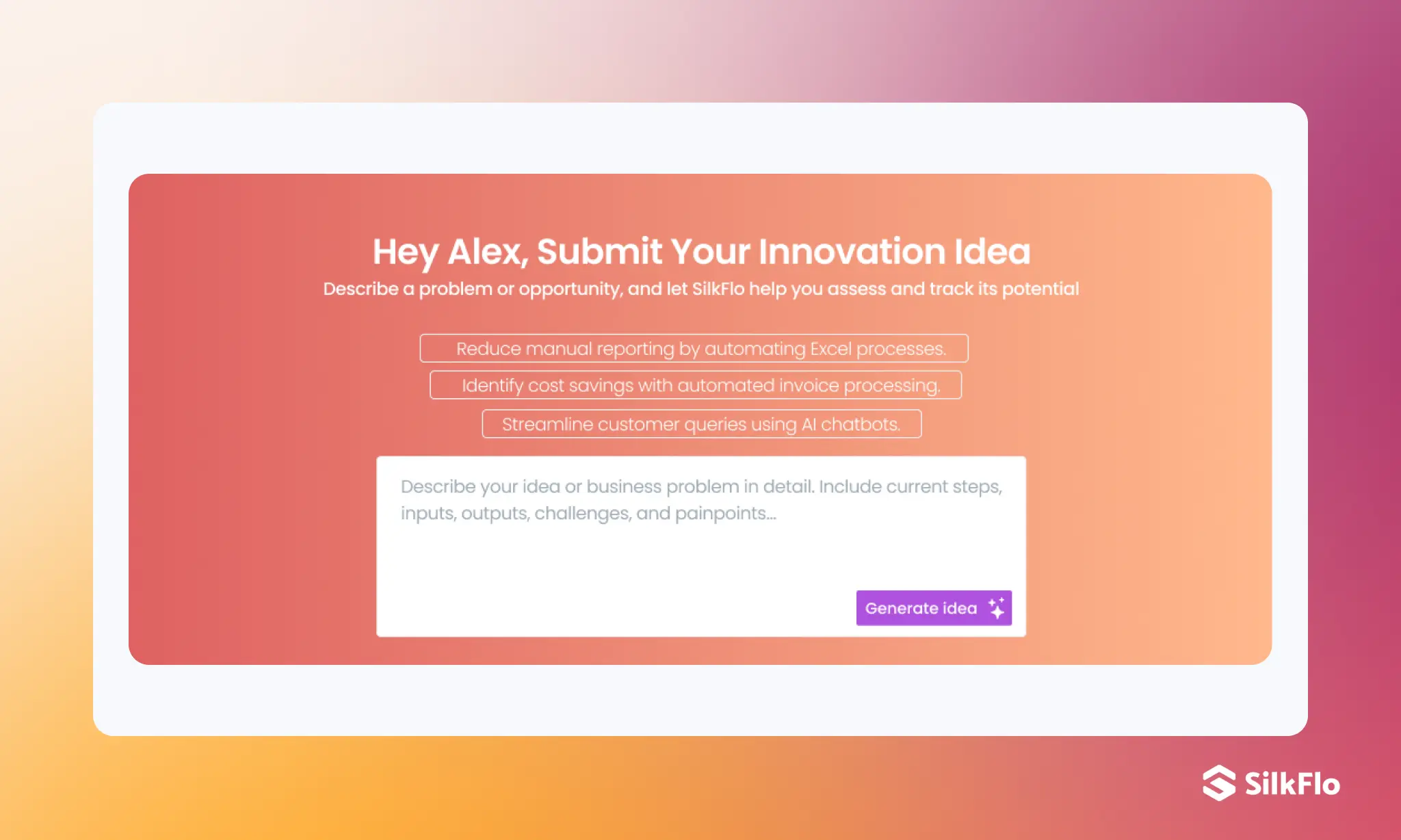
The traditional manual discovery process is a bottleneck for digital transformation. Business analysts usually spend weeks running workshops, interviewing staff, mapping processes on whiteboards and writing up tedious documentation. By the time the pipeline is prioritised, the momentum is completely gone.
Look at Staffordshire County Council. They refused to get stuck in endless discovery workshops. They needed to move fast without losing governance over their pipeline. They adopted SilkFlo to let their frontline staff describe operational problems in plain English.
During live workshops, staff use SilkFlo’s AI-assisted intake feature. The AI acts as a junior business analyst. It asks dynamic, context-aware questions to pull out the necessary details regarding frequency, manual hours involved or specific risk factors. The software does the heavy lifting of turning those raw frustrations into a professional project charter. The council leaves the workshop with a portfolio of standardised project charters that are ready for financial review.
The 6 Value Drivers: Moving Beyond “Hours Saved”
Crowdsourcing ideas is only valuable if you can identify the initiatives that deliver tangible financial impact. A major issue with vendor-driven AI projects is the Vendor Math Trap. Vendors try to sell councils on vague metrics like “hours saved” or “improved productivity.” Saving a planning officer 30 minutes a day on drafting emails does not balance a multi-million-pound budget deficit.
When a staff member submits an idea through SilkFlo, the platform forces the initiative to be evaluated through Dynamic Assessments. Instead of relying on theoretical time savings, the AI maps the project against six grounded value drivers. This populates a rigorous 3-Column Business Case Builder covering CapEx, OpEx and Value.
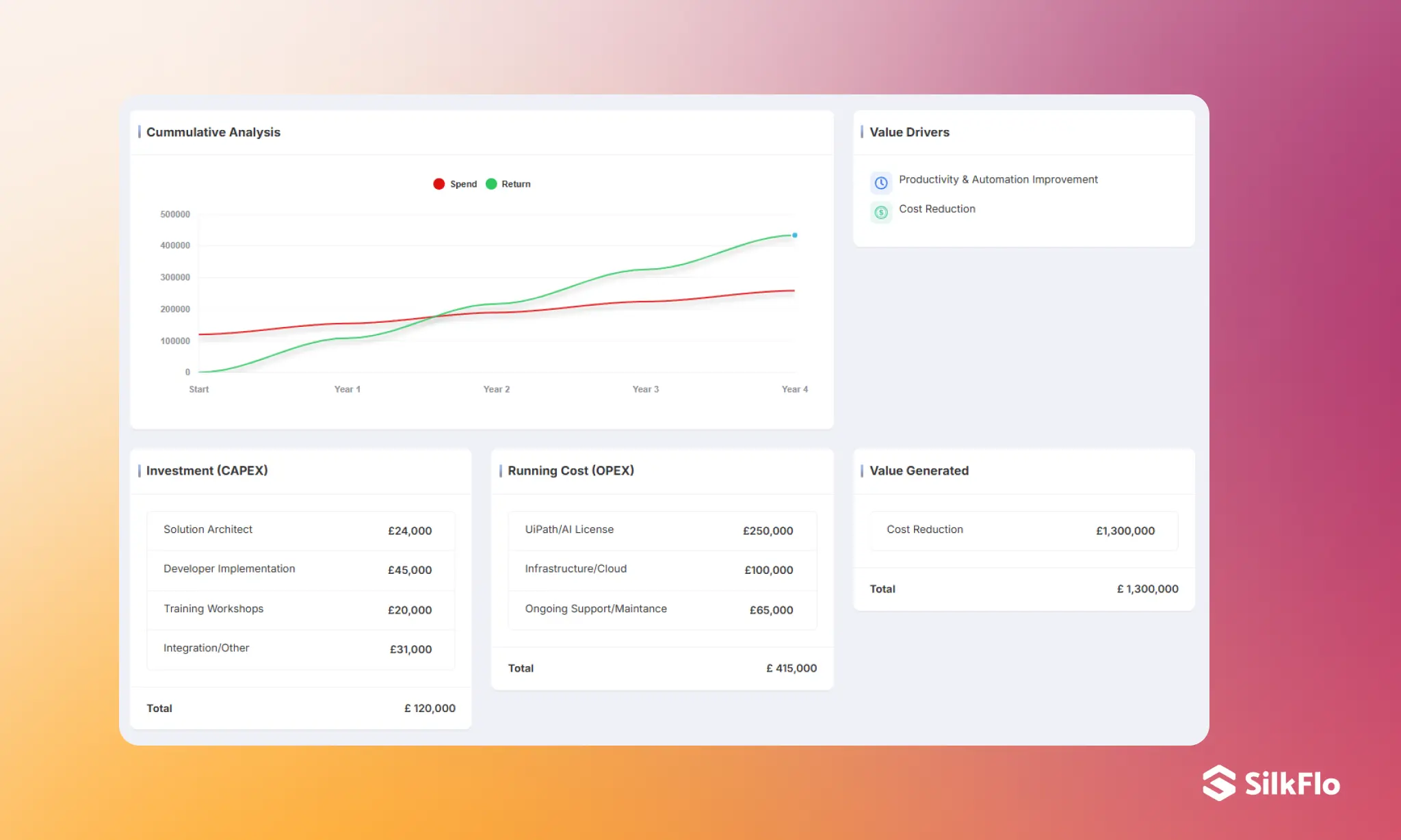
These six drivers translate technical projects into the language of corporate finance:
- Cost: Hard cash removed from the operational baseline through retired legacy software or reduced outsourcing.
- Revenue: Additional income generated or recovered quickly, such as automating council tax arrears processing.
- Risk: Financial penalties avoided by maintaining data compliance or meeting strict statutory timelines.
- Customer Experience (CX): Measurable reductions in citizen wait times and official complaint volumes.
- Employee Experience: Reduction in staff burnout and the associated costs of recruitment.
- Productivity (Capacity Released): The exact volume of new statutory workload the technology absorbs without requiring the council to hire new headcount.
By tying every crowdsourced idea to these specific drivers, Digital managers can instantly see the current “as is” state against the council’s target “to be” state.
Tying Tech Initiatives to Council Strategy
IT projects fail when they disconnect from the council’s wider corporate plan. SilkFlo provides a clear view of the current ‘as is’ state against strategic targets. You see exactly how daily friction connects to statutory priorities.
These are concrete, practical realities. We see councils automate the specific, high-friction tasks that keep teams working late. Concrete examples of crowdsourced public sector automations include:
- Moving Deprivation of Liberty Safeguards (DoLS) standard authorisation forms into CareDirector.
- Processing child plan distributions and safeguarding contact distribution.
- Automating MP complaints about highways.
- Sending care home purchase order letters.
- Updating legacy systems, like saving to Contents Manager (TRIM) or WordPress websites.
- Submitting annual reviews on Capita from the EHC Hub.
- Managing probation requests and third-party claims.
Automating these tasks delivers Capacity Released. Your highly trained staff spend more time on frontline service delivery rather than data entry. SilkFlo tracks this transition in real time to show whether the technology is meeting the targets set in the initial charter. Read more about the government’s own AI playbook.
Pipeline Governance: The Value vs. Effort Matrix
Opening the floodgates to staff suggestions usually creates a governance nightmare – we’ve all seen how Miro boards or Idea Management tools become overwhelmed by low-value requests. SilkFlo filters the noise using a Value vs. Effort Matrix.

Every submitted project charter is mapped onto this matrix based on technical effort and six specific value drivers: Cost, Revenue, Risk, Customer Experience, Employee Experience and Productivity. This allows the Digital Manager to visually present the pipeline to the Section 151 Officer. You instantly filter out high-effort vanity projects and approve the quick wins that deliver immediate Value for Money.
Surviving Local Government Reorganisation
This level of governance becomes critical during Local Government Reorganisation (LGR). When district and county councils merge into new unitary authorities, digital IP usually gets lost in the chaos. Teams rely on disconnected spreadsheets. You end up with orphaned automations and duplicate software licenses.
Before LGR work begins, the transition team must build an agnostic Digital Asset Register. SilkFlo maps the combined digital footprint of all merging entities. The new unitary council inherits a clean portfolio of standardised Solution Blueprints to identify redundancies and guarantee day-one synergy savings.
Councils also suffer from the Vendor Math Trap during these transitions. Vendors grade their own homework with vanity metrics like “hours saved” to sell more Microsoft Copilot or other software licenses. SilkFlo breaks this cycle with a strict Forecast vs Realised loop. If an automated safeguarding contact distribution was forecasted to release £50,000 in capacity, the platform audits the post-deployment reality to prove that value was actually delivered.
Build a Pipeline That Survives Scrutiny
Defending your digital transformation budget is exhausting when you only have theoretical “hours saved” to show for your efforts. You need an innovation pipeline built on hard financial evidence. Our case studies show how other public sector teams have built exactly that.
We will skip the standard software pitch. Instead, we will look at your current automation backlog, identify where your council might be caught in the Vendor Math Trap and show you exactly how to map your upcoming projects to the six value drivers.
Whether you are preparing for a complex merger or simply trying to protect your existing team from budget cuts, you will leave the call with a clear framework to prove actual Capacity Released.
Frequently Asked Questions (FAQ)
How does SilkFlo’s AI-assisted intake help non-technical council staff?
SilkFlo provides an AI-assisted intake portal that guides council employees through a conversational process to capture the details of their innovation ideas. It translates operational friction into a structured project charter by asking questions about volumes, time spent and risks. This allows frontline staff to contribute high-quality business cases without needing to understand the underlying technology or financial modelling.
What is the Value vs. Effort Matrix in digital transformation?
The Value vs. Effort Matrix is a core feature in SilkFlo that allows council leaders to prioritise their digital pipeline based on objective data rather than departmental politics. SilkFlo automatically plots every potential project on a graph to show which initiatives will deliver the highest financial impact for the least amount of technical work. This ensures limited council resources are spent on quick wins rather than high-cost projects with minimal benefit.
How do councils protect their digital IP during Local Government Reorganisation (LGR)?
Councils use SilkFlo as an agnostic Digital Asset Register to protect their IP during a merger. SilkFlo standardises how business cases are written and tracked across all merging entities. This visibility allows transition leadership to instantly identify redundant software licenses and prioritise the combined innovation pipeline for maximum synergy savings on day one of the new unitary authority.
How does SilkFlo prevent the Vendor Math Trap?
SilkFlo prevents the Vendor Math Trap by enforcing a strict Forecast vs Realised Loop. This governance framework compares the initial financial benefits promised in a business case against the actual value delivered after the technology is live. It ensures vendors and internal teams are held accountable for their ROI projections. This prevents councils from buying software licenses based on theoretical hours saved and proves actual Capacity Released to the Section 151 Officer.