AI portfolio management is the practice of running every AI and automation initiative in your organisation as one portfolio: one register from idea to retirement, one business case and one set of actual results per initiative, and a regular decision on what to scale, fix or stop. It is about managing your own AI investments, not using AI to pick stocks. When it works, the board’s question “what has AI returned?” has one answer instead of ten spreadsheets.
This guide covers what an AI portfolio contains, the lifecycle and register behind it, how to get one view across a mixed toolkit, how to stop duplicated work, how to report without rebuilding the pack every month, and who should own the numbers.
Why AI needs managing as a portfolio
Most organisations see AI value in patches. In Dun & Bradstreet’s survey of 10,000 businesses, 48% reported ROI only in limited pockets, against 28% reporting broad returns across several projects. Pockets of ROI is what a portfolio with no register looks like: a few teams can prove their numbers and nobody can add them up.
The organisations that pull ahead manage AI as a portfolio. BCG’s 2025 study of 1,250 executives found only 5% of companies are “future-built” for AI and achieving value at scale, while 60% report minimal revenue and cost gains. Gartner’s 2026 survey of more than 1,300 leaders found that organisations that track ROI constantly, manage AI as a portfolio and stop underperforming initiatives reported positive returns on 81% of their AI initiatives.
The common thread is discipline across the whole estate, not cleverness in any one project.
What is in an AI portfolio?
Everything the organisation spends on AI and automation, whatever its stage or supplier:
- Ideas submitted by staff and teams, not yet assessed
- Pilots and proofs of concept, often running in a single department
- Live tools, such as Microsoft 365 Copilot seats, a claims triage model or an RPA estate
- Agents and automations built by citizen developers on low-code platforms
- Vendor contracts and licences that carry a recurring cost
- Retired initiatives, kept on record with their results and the reason they stopped
Each item carries a business case, a stage, an owner and, once live, a realised value figure. Treating them as one portfolio is the operating model behind benefits realisation management, applied to AI.
The AI portfolio lifecycle
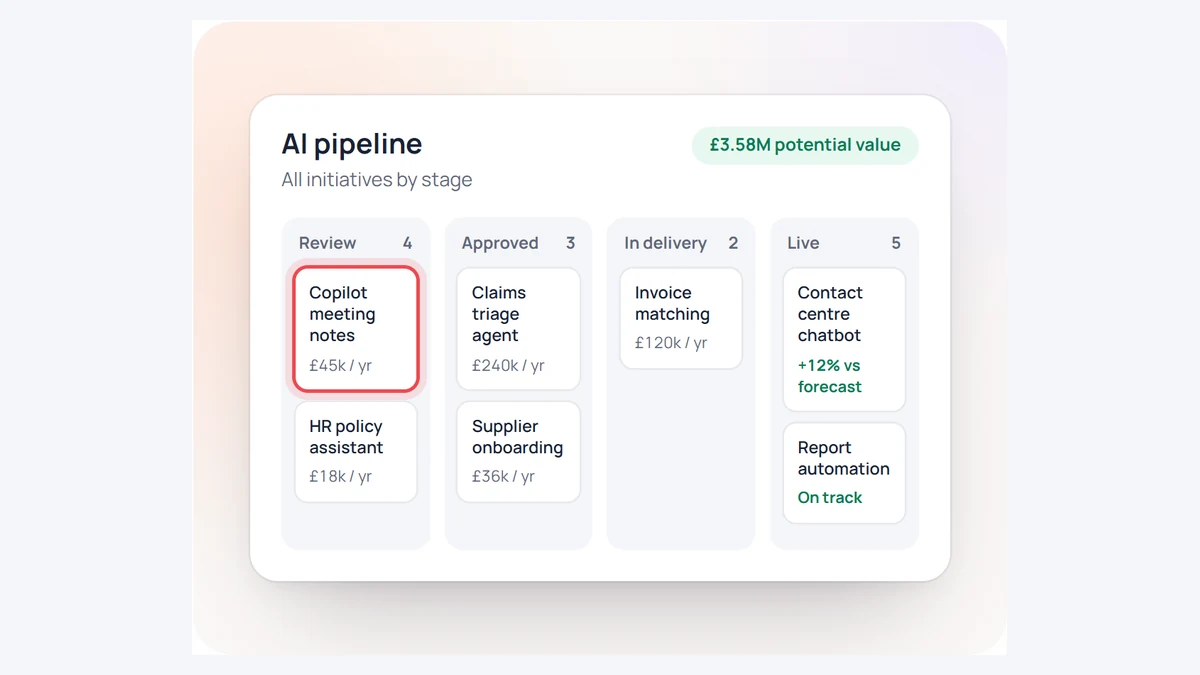
Run every initiative through the same stages so they can be compared, funded and reported on the same terms.
| Stage | What happens | Decision at the gate |
|---|---|---|
| Intake | An idea is submitted in plain words, with the problem it solves | Is it worth assessing? |
| Assessment | Feasibility, value drivers, data and risk are checked | Is it worth a business case? |
| Business case | Costs, benefits, owner and baseline are set | Fund, defer or reject |
| Build | The solution is built and tested | Ready to go live? |
| Live | It runs, and actuals are logged monthly | On track, behind or not delivering? |
| Review | Forecast is compared with actual | Scale, fix or stop |
| Retire | It is switched off and its results are recorded | Lessons kept |
Each organisation can name the stages in its own words, as long as every initiative passes through the same gates. The AI ROI metrics guide covers what to measure at the live and review stages.
The AI use case register
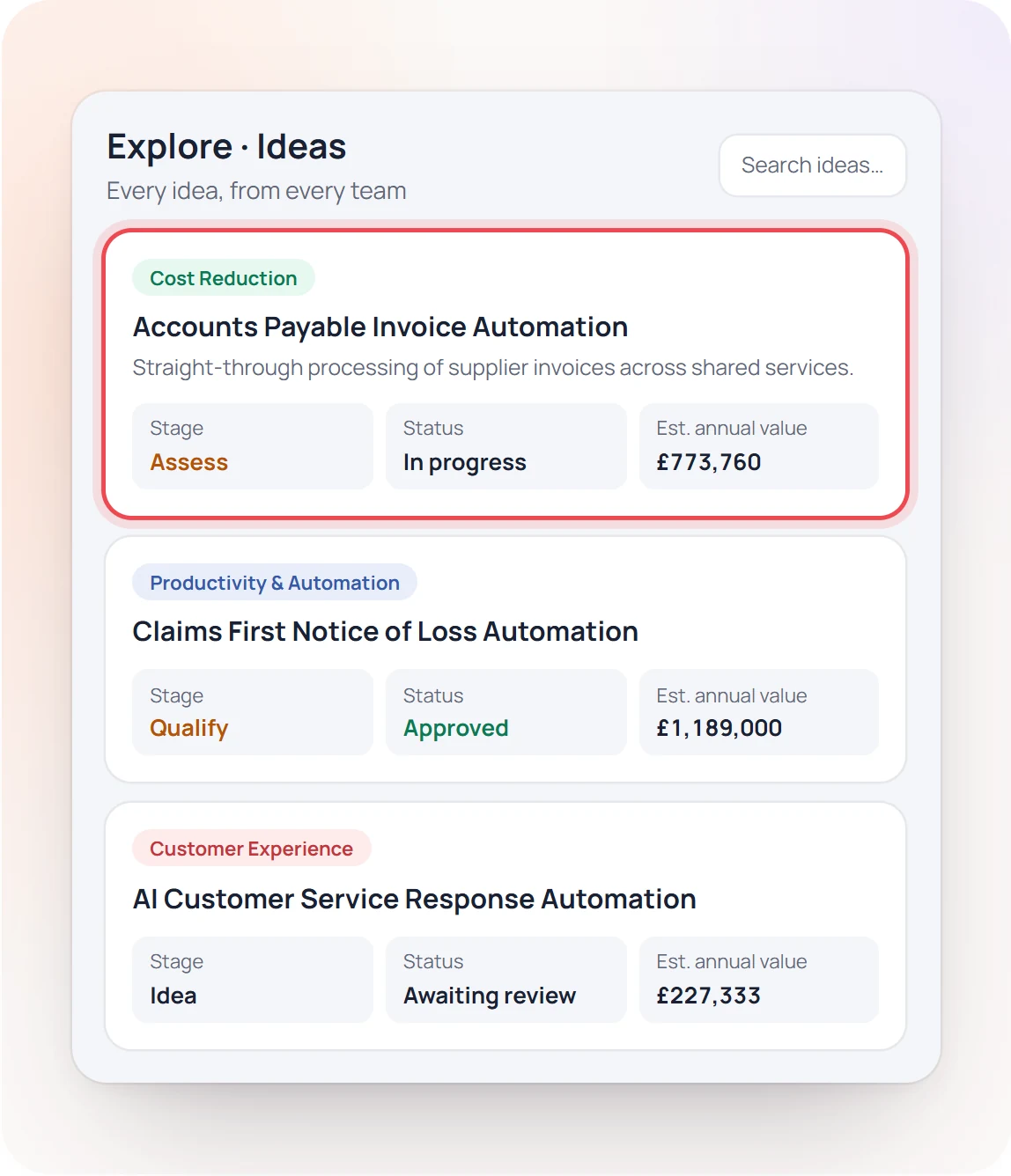
The register is the single record of the portfolio. A practical template:
| Field | What goes in it |
|---|---|
| Initiative | What it does, in a sentence |
| Owner | The person accountable for its value, not just its delivery |
| Department | Where it runs and who benefits |
| Platform and supplier | Microsoft 365 Copilot, Microsoft Power Automate, UiPath, Agentforce, an in-house model |
| Stage | Where it sits in the lifecycle |
| Value drivers | Productivity, cost, revenue, customer experience, compliance and risk, employee experience |
| Total cost | Licences, build, run and internal time |
| Forecast benefit | From the approved business case |
| Actual benefit to date | From finance and operational systems |
| Status | On track, behind or not delivering |
| Documents | Business case, approvals, assessments, reviews |
| Next decision | Date and gate |
Keep it in one place that every team uses. A register that only the central team updates goes stale within a quarter.
Our AI programme is at the ‘chaos stage’. How do we get one view across the whole toolkit?
Put every tool in the same register with its own cost line, whichever vendor supplies it. Most programmes reach a point where Copilot, ChatGPT Enterprise, an Agentforce pilot and an RPA estate all run at once, each with its own dashboard. KPMG’s Q2 2026 AI Pulse found 42% of leaders have only partial visibility into their AI spending, and organisations with full visibility of AI running costs were five times more likely to report established ROI.
One view needs one cost model: a standard cost per tool that every business case draws on, so total AI spend comes from one source. Vendor dashboards stay useful for adoption data, but each reports only on its own product. For a comparison of governance tools, see our guide to UiPath Automation Hub alternatives.
How do we see across departments and federated teams to stop duplicated AI work?
Make the central register the only route to funding. When every department submits through the same front door, two teams building the same document summariser show up as duplicates at intake, before either spends money.
Federated centres of excellence keep local ownership of delivery while the register gives the central team sight of the whole pipeline. Three habits make it stick:
- One intake for everyone. No funding without a register entry, whichever team or supplier is involved.
- Search before you build. New ideas are checked against existing entries at assessment.
- Share what works. Live initiatives with strong results are flagged for reuse in other departments.
Our guide to setting up an AI centre of excellence covers the operating structure.
How to govern the portfolio
Governance is a cycle, not a committee. Run it monthly.
- Refresh actuals. Pull results for every live initiative from finance and operational systems.
- Check the gates. Move initiatives that are ready, and send back those that are not.
- Review the variance. Compare forecast with actual for each live initiative and for the portfolio as a whole.
- Decide. Scale what is beating its business case, fix what is close, stop what is not delivering.
- Reallocate. Move budget and people from stopped initiatives to the ones that are working.
- Record the decisions. Every change to a business case, and every stop, is logged with who decided and why.
For AI agents in particular, the record behind each decision matters as much as the decision. Our guide to AI agent governance sets out the audit trail from idea to live agent, and the digital asset register guide shows how public bodies hold the same view through a reorganisation.
Steering committee reporting eats our week. How do we stop rebuilding the report by hand?
Report from the register, not from a deck. If every initiative’s stage, cost, forecast and actual live in one place, the steering committee pack is a filtered view of the register rather than a new document.
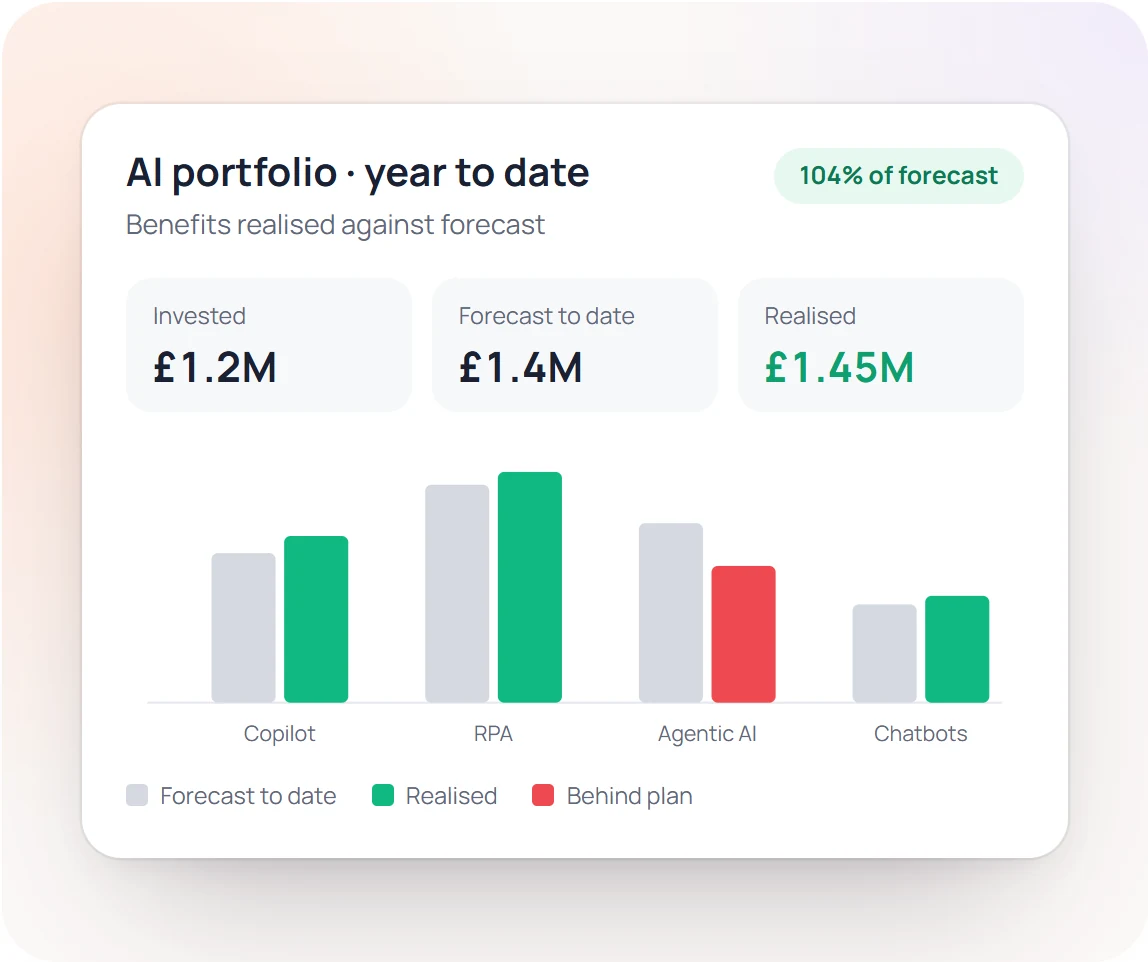
A standard one-page pack has four parts:
| Section | What it shows |
|---|---|
| Portfolio totals | Total spend, forecast benefit, actual benefit and the gap |
| Movement | What entered, moved stage, scaled or stopped since last time |
| Exceptions | The few initiatives that are behind or need a decision |
| Decisions needed | What the committee is asked to approve today |
Everything else is available on request rather than printed every month. Our guide to reporting AI to the board covers the board version in more detail.
Who owns proving AI value? Governance has a budget; value realisation doesn’t.
Give the value numbers to finance, even when a transformation or AI lead runs the register. A study by the Return on AI Institute and Babson College of 1,006 executives found only 2% of organisations make the CFO responsible for delivering AI value, yet 76% of those that do report a great deal of value. KPMG found organisations where the CEO is accountable for AI outcomes are far more likely to report established ROI, 14% against 4%.
In practice the split that works is:
- The CFO decides what counts as a benefit and signs off the value numbers.
- The CIO or AI lead runs the register, the gates and the delivery.
- Benefit owners in each department are accountable for their own initiatives’ results.
When value realisation has no budget, fund it from the portfolio itself. A small share of AI spend set aside for measurement pays for itself the first time it stops an initiative that was not delivering.
How should an AI centre of excellence measure its success?
By the value of the portfolio it runs, not the number of things it built. Useful measures for a CoE:
- realised value across the portfolio against forecast
- the share of initiatives with a baseline and an owner
- time from idea to funded business case
- the number of underperforming initiatives fixed or stopped
- duplicate ideas caught at intake
A CoE that reports these each quarter is easy to fund. One that reports bots built and hours saved is not. The ROI maturity assessment gives a quick benchmark of where yours stands.
The four stages of AI portfolio maturity
Most organisations move through the same four stages. Knowing which one you are in tells you what to fix next.
| Stage | What it looks like | What to fix next |
|---|---|---|
| 1. Scattered | Pilots in several departments, no central list, value claimed in anecdotes | Build one register and get every initiative into it |
| 2. Listed | A register exists, but business cases are thin and actuals are rarely recorded | Require a costed business case and a named owner before funding |
| 3. Tracked | Business cases and actuals sit side by side, reviewed monthly | Act on the data: scale, fix or stop, and reallocate budget |
| 4. Managed | Funding follows evidence, and the board sees one portfolio view | Keep the cycle running and widen it to every new tool |
The jump from stage 2 to stage 3 is where most programmes stall, because it needs actual results from finance and operational systems rather than estimates.
Common mistakes in AI portfolio management
- Counting activity as value. Bots built, users onboarded and hours saved describe effort, not return.
- Leaving licences out of the register. Copilot seats and platform contracts are part of the portfolio, and often its biggest cost.
- Never stopping anything. A portfolio where nothing is ever retired is not being managed. Stopping weak initiatives is how money reaches strong ones.
- One owner for everything. The central team cannot be accountable for every benefit. Each initiative needs an owner in the department that gains.
- Annual reviews only. By the time a yearly review spots a failing initiative, it has run for a year.
What good looks like: Aviva
Before SilkFlo, Aviva UK’s Claims Innovation team ran strategy in Planview and ideation on Miro post-it boards, with no way to forecast, prioritise ideas or track benefits. Moving the pipeline into one register changed that. In three weeks the team qualified 102 opportunities and identified £12 million in cost-saving opportunities, at £865 against £75,600 for a traditional consulting approach. Every opportunity entered the portfolio with a costed business case, which is what makes later forecast-vs-actual tracking possible.
How SilkFlo helps
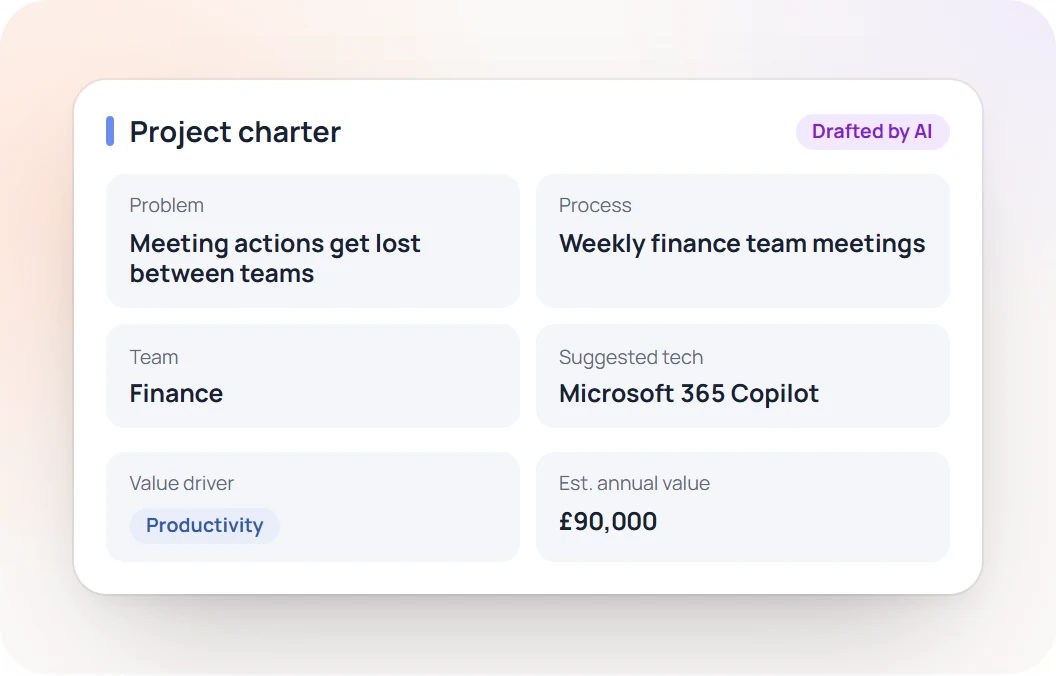
SilkFlo is the AI Value Realization Platform: AI portfolio management built around value, from the first idea to the benefits it returns. Staff describe an idea in plain words and AI classifies the value driver, fills the intake form and seeds an ROI estimate, while twenty ready-made solution templates prefill typical costs and benefits for common rollouts. Every initiative moves through stages your organisation names, with approval decisions recorded at each gate.
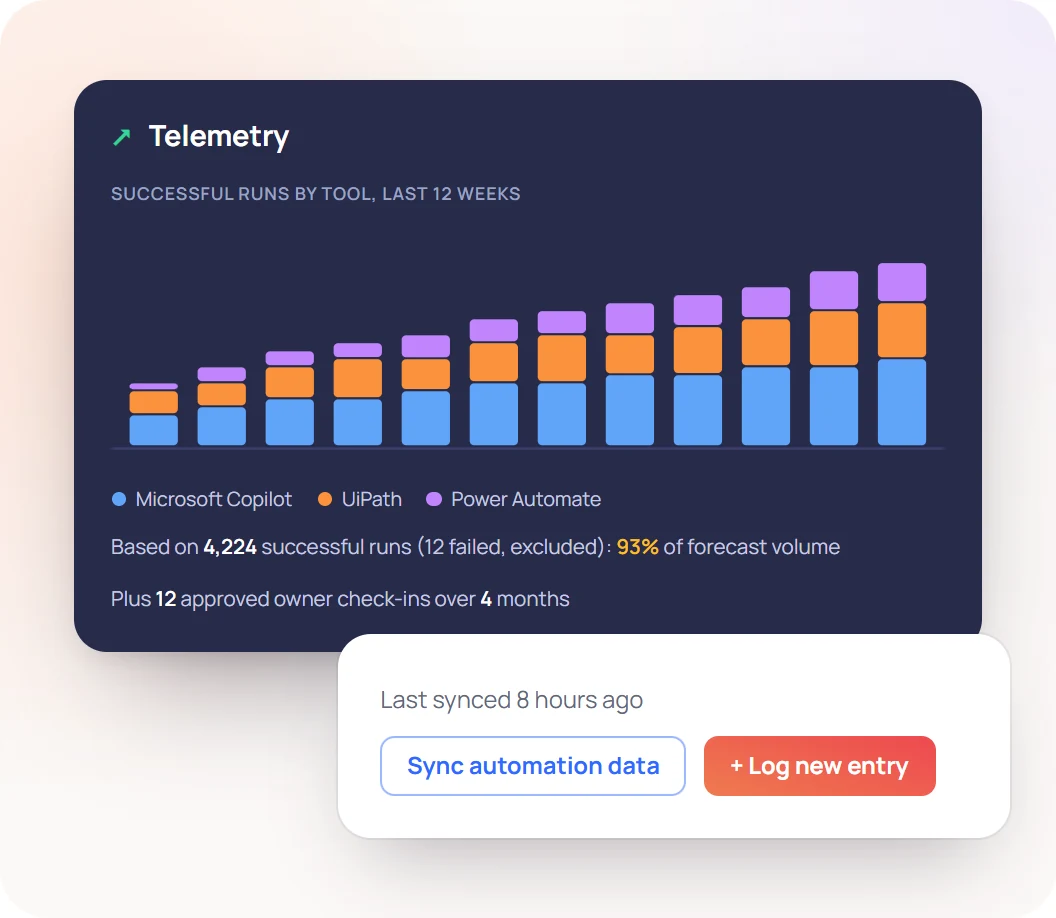
After go-live, run and usage data from any AI or workflow tool, including your RPA platforms, comes in through the SilkFlo API and feeds the same value tracking as every other initiative. Pipeline summary tiles show portfolio value at a glance, every change to a business case is logged.
It is built for AI centres of excellence running the register and finance teams signing off the numbers. To size a single initiative, use the free AI ROI calculator. For the measurement method, see how to measure AI ROI. To see the portfolio view on your own initiatives, book a SilkFlo demo.
Frequently Asked Questions
What is AI portfolio management?
Steering committee reporting eats our week. How do we stop rebuilding the report by hand?
Report from the register, not a deck. A one-page pack of portfolio totals, movement, exceptions and decisions needed can be produced as a filtered view of the register each month.
How do we see across departments and federated teams to stop duplicated AI work?
Make the central register the only route to funding, check new ideas against existing entries at assessment, and flag strong initiatives for reuse. Federated teams keep delivery; the centre sees the whole pipeline.
Who owns proving AI value? Governance has a budget; value realisation doesn’t.
Give the value numbers to finance: the CFO decides what counts as a benefit and signs off the figures, the CIO or AI lead runs the register, and benefit owners answer for their own initiatives. Fund measurement from a small share of the portfolio.
Our AI programme is at the ‘chaos stage’. How do we get one view across the whole toolkit?
Put every tool in one register with its own cost line, whichever vendor supplies it, and use one cost model so total spend comes from one source. Vendor dashboards then supply adoption data rather than the portfolio view.
How should an AI centre of excellence measure its success?
By realised value against forecast across the portfolio, the share of initiatives with a baseline and owner, time from idea to funded business case, underperformers fixed or stopped, and duplicates caught at intake.
Microsoft, Microsoft 365 Copilot, Microsoft Copilot and Microsoft Power Automate are trademarks of the Microsoft group of companies.