A digital asset register for local government reorganisation is one record of every digital and AI programme a council runs: what it cost, what it was meant to deliver, what it has delivered and who owns it. With reorganisation paused, it matters more, not less. Paused programmes lose their owners, baselines and evidence while nobody is looking, and a register keeps that value on record for auditors, members and any future authority, whether your council merges in 2028, later or never.
This guide is part of our wider guide to AI portfolio management. It covers where reorganisation stands, what a register contains, and how to build one in 60 days.
Where local government reorganisation stands
On 7 September 2026 the government withdrew reorganisation decisions for Essex, Hampshire, Norfolk and Suffolk in light of new legal advice, and paused 14 other decisions for review. According to Local Government Lawyer, two areas still awaiting decisions were brought into the review, and Surrey’s reorganisation continues, with East Surrey Council and West Surrey Council still due to go live in April 2027. Elections in May 2027 go ahead on existing boundaries.
The review is led by local government minister Jim McMahon. Speaking in October, he said there may need to be “transitional arrangements” for areas involved in devolution if reorganisation is delayed, and that he hoped to clarify the timetable soon. Until he does, any restart date is guesswork.
With LGR coming, do we transform now or do nothing for three years?
Transform now, but on evidence. The case for waiting is that a new authority may change direction. The case against is stronger: a three-year freeze is long enough for the officers who know why a programme exists to move on, for baselines to go stale and for business cases to become unreadable. When decisions are finally made, programmes with no evidence behind them are the easiest to cut, whether or not they worked.
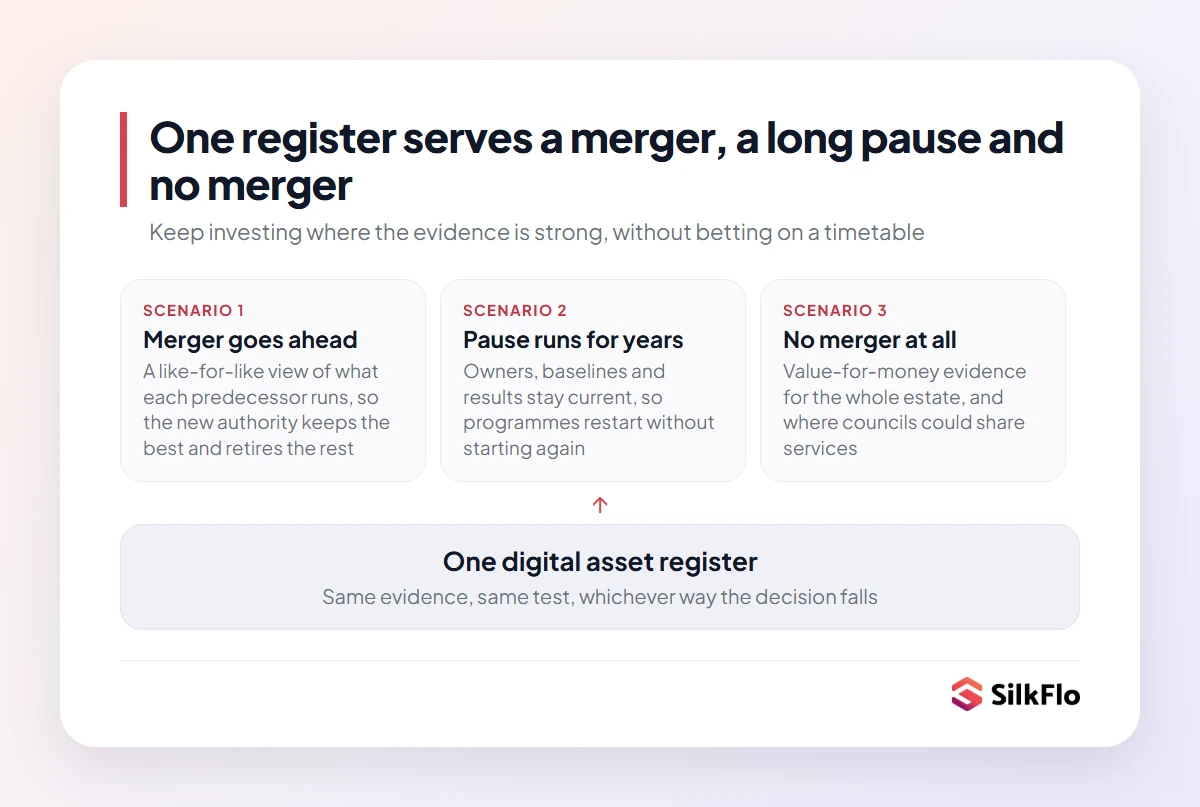
A register lets a council keep investing where the evidence is strong and stop where it is not, without betting on a timetable. The test is the same in every scenario:
| Scenario | What the register does |
|---|---|
| Merger goes ahead | Gives the new authority a like-for-like view of what each predecessor runs, so it keeps the best and retires the rest |
| Pause runs for years | Keeps owners, baselines and results current so programmes can restart without starting again |
| No merger at all | Gives auditors and members value-for-money evidence for the whole estate, and shows where councils could share services |
The money is also tight. Most councils preparing for reorganisation are doing so under severe financial pressure, so every pound of digital spend needs to show what it returns. Our guide to value for money in local government covers the evidence finance will look for.
What is a digital asset register for councils?
It is a benefits register for the whole digital and AI estate. Most councils track programmes across SharePoint lists, project tools, email chains and the memories of a few senior managers. That works day to day, but it does not survive a restructure, a long pause or a change of leadership, because none of it is portable, comparable or auditable. A register puts it all in one format.
It has three parts.
1. Programme inventory
Every active, paused or recently completed digital and AI initiative, sorted by service area, investment, delivery stage and platform. That includes Copilot deployments, Power Automate flows, UiPath and Blue Prism programmes, AI-assisted triage in social care or housing, and contracted transformation work. Include paused programmes in particular. They are the ones most at risk.
2. Value evidence
For each initiative: the investment approved, the benefit forecast, and what has actually happened since go-live in the council’s own data. That means officer time freed and what it became (lower cost, more cases handled, backlog cleared), cash saved, and resident outcomes where they exist. This is the evidence the Best Value duty asks for, and what an external auditor or scrutiny committee will want to see, merger or no merger.
3. Cross-authority comparison
If reorganisation goes ahead, neighbouring councils may each run a housing benefit automation on a different platform. Without a shared view, the new authority keeps all three or cuts all three. With a register in a common format, it can see which has the strongest record and consolidate around it. The same view helps councils that never merge but want to share services.
The register template
These are the fields to capture for each programme. Keep them the same across every directorate, and across neighbouring authorities if you can agree it.
| Field | What goes in it |
|---|---|
| Programme and service area | What it does, and where |
| Platform and supplier | For example Copilot, Power Automate, UiPath, a contracted service |
| Owner | The named officer accountable for its benefit, not only its delivery |
| Status | Live, paused, in delivery or retired |
| Investment to date | Build, licences, contracts and officer time |
| Annual running cost | What it costs to keep going |
| Forecast benefit | What the business case promised |
| Actual benefit to date | From finance, HR or case systems, split into cash and capacity |
| Resident outcome | Processing times, satisfaction, referral throughput, where measured |
| Documents | Business case, approvals, data protection impact assessment, reviews |
| Recommendation | Continue, merge, scale or retire |
How do we track every idea from submission to post-deployment in one place?
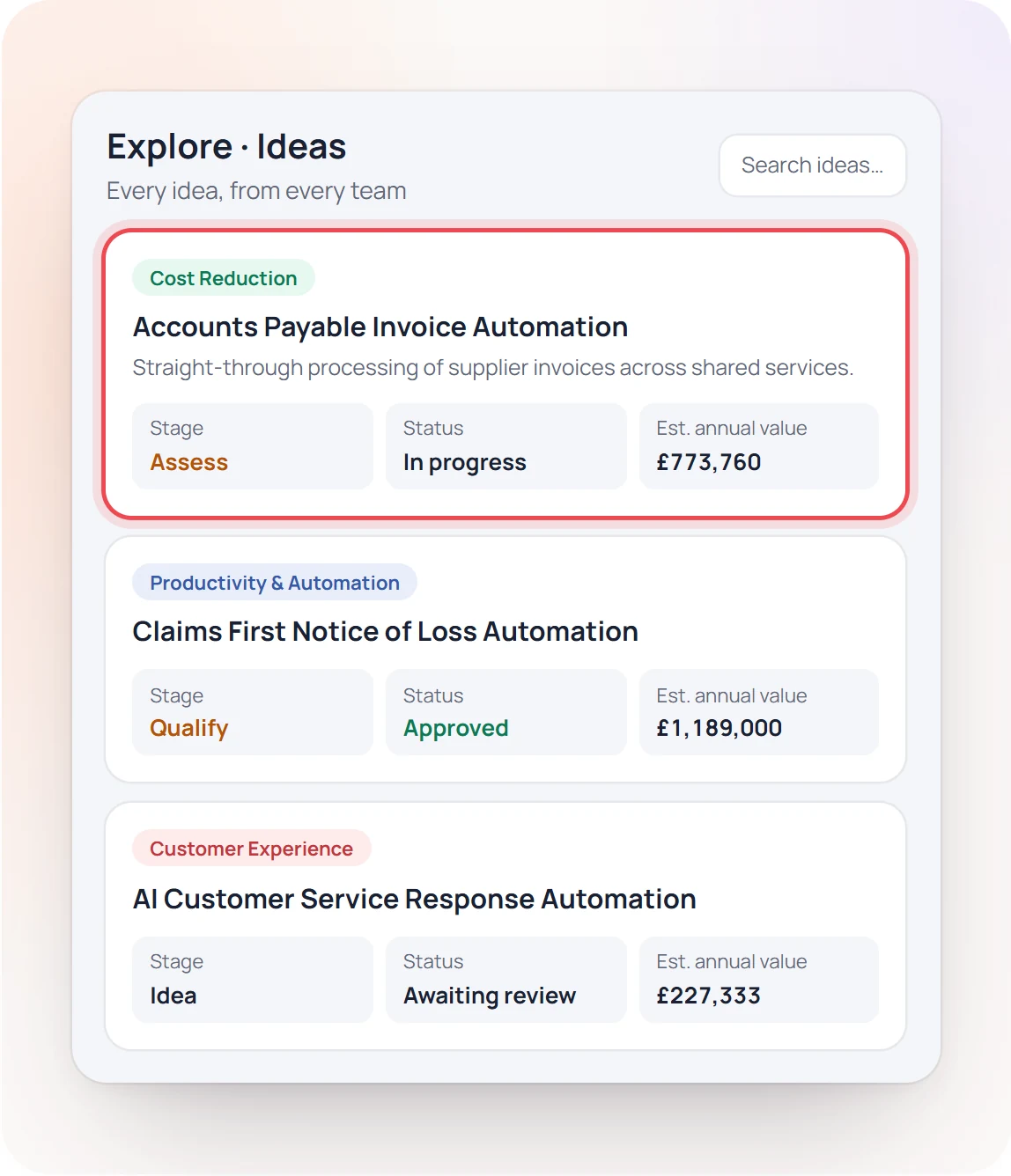
Use the register as the single front door, not only a list of what already exists. New ideas enter it at submission, move through assessment and approval inside it, and stay in it after go-live with their results attached. That way the register never goes out of date, because it is how work gets done rather than a separate return someone fills in once a year.
Three habits keep it alive:
- One route in. Every new digital or AI idea is submitted the same way, whichever team or supplier is involved.
- Results after go-live. Each live programme is reviewed monthly against its business case, so the value evidence stays current.
- Documents with the record. Business cases, approvals and reviews sit with the programme they describe, not in personal drives.
How to build a register in 60 days
- Weeks 1 to 2: inventory everything. Every active, paused or recently completed digital and AI initiative, including anything that touches resident data or service delivery, whether or not it is labelled AI.
- Weeks 3 to 4: standardise the record. Use the template above. Where no business case exists, record today’s performance as the baseline so there is something to measure against later.
- Weeks 5 to 6: add the evidence. Pull actual results from the council’s own systems, not the vendor’s figures. A Copilot rollout said to save 500 officer hours a month that has changed neither cost nor throughput has not yet delivered value. Our AI ROI framework for local councils covers how to count freed capacity.
- Week 7: name an owner for every paused programme. A paused programme with an owner and a baseline can restart. One without either is effectively cancelled.
- Week 8: start the monthly review. Compare what each business case projected with what the programme delivered, and flag anything delayed, overstated or not turning into real savings.
To test the numbers on any programme, the free AI ROI calculator works out return and payback from costs and benefits.
How SilkFlo helps
SilkFlo is a single register of every digital, AI and automation initiative, from first idea to retirement, whichever supplier delivers it. Councils can bring in the lists they already hold, so the register does not start from a blank page. Each initiative carries its business case, documents and approvals, and actual results are pushed in live from council systems through the SilkFlo API, so the comparison between forecast and actual stays current however long the pause lasts.
Staffordshire County Council uses SilkFlo to track UiPath, Power Automate and Microsoft Copilot in one place that no vendor controls. When an auditor or a new authority asks what an investment was meant to deliver, the answer is on record rather than in someone’s memory. SilkFlo is listed on G-Cloud 15. To see a register in action, book a SilkFlo demo.
For the audit trail behind each AI agent in the register, see our guide to AI agent governance in UK local government.
Frequently Asked Questions
Digital asset register for local government reorganisation
How do we track every idea from submission to post-deployment in one place?
Make the register the single front door: new ideas are submitted into it, assessed and approved inside it, and stay in it after go-live with monthly results attached. Keep the documents with each record.
With LGR coming, do we transform now or do nothing for three years?
Transform now, on evidence. A long freeze loses owners, baselines and business cases. A register lets a council keep investing where the evidence is strong and stop where it is not, whatever happens to its boundaries.
What is a digital asset register for councils?
One auditable record of every digital and AI programme a council runs: what it cost, what it was meant to deliver, what it has delivered, who owns it and the documents behind it. It shows which programmes create value, so decisions to continue, merge or retire them rest on evidence.
Microsoft, Microsoft Copilot, Microsoft Power Automate and Microsoft SharePoint are trademarks of the Microsoft group of companies.