
The best UiPath Automation Hub alternatives are the tools that can govern every AI and automation initiative, whichever platform delivers it, and show what each one returned against its business case. Automation Hub does the pipeline job well inside a UiPath estate. Most enterprises now also run Microsoft Copilot, Power Automate, Salesforce Agentforce and a few GenAI tools nobody planned for, and Automation Hub sees only one of them.
This comparison is part of our guide to AI portfolio management. It covers where Automation Hub stops, the five criteria that matter, five alternatives side by side, and a way to choose.
Where UiPath Automation Hub stops
Automation Hub is UiPath’s CoE management layer. It covers idea submission, assessment scoring, pipeline views, projected ROI and documentation, and it gives the business a way to submit ideas without going through IT. For a UiPath-first estate, it is a sensible choice.
Two limits push teams to look elsewhere.
It is built for one vendor. Automation Hub sits within the UiPath platform. Work delivered in Power Automate, Agentforce, GenAI tools or custom models sits outside it, so a CoE running UiPath alongside three other platforms sees part of its portfolio at best.
Projected ROI is not actual ROI. Automation Hub shows projected benefit at the proposal stage. Comparing that projection with what deployed automations actually did relies on UiPath Insights, a separate analytics product with an Automation Hub integration and an ROI comparison dashboard. Even combined, the figures are built from robot run data and ROI values an administrator enters. They are not checked against headcount, operating cost or what happened to the freed time, so a CFO asking what the programme did to the P&L still has no answer.
What to look for in an Automation Hub alternative
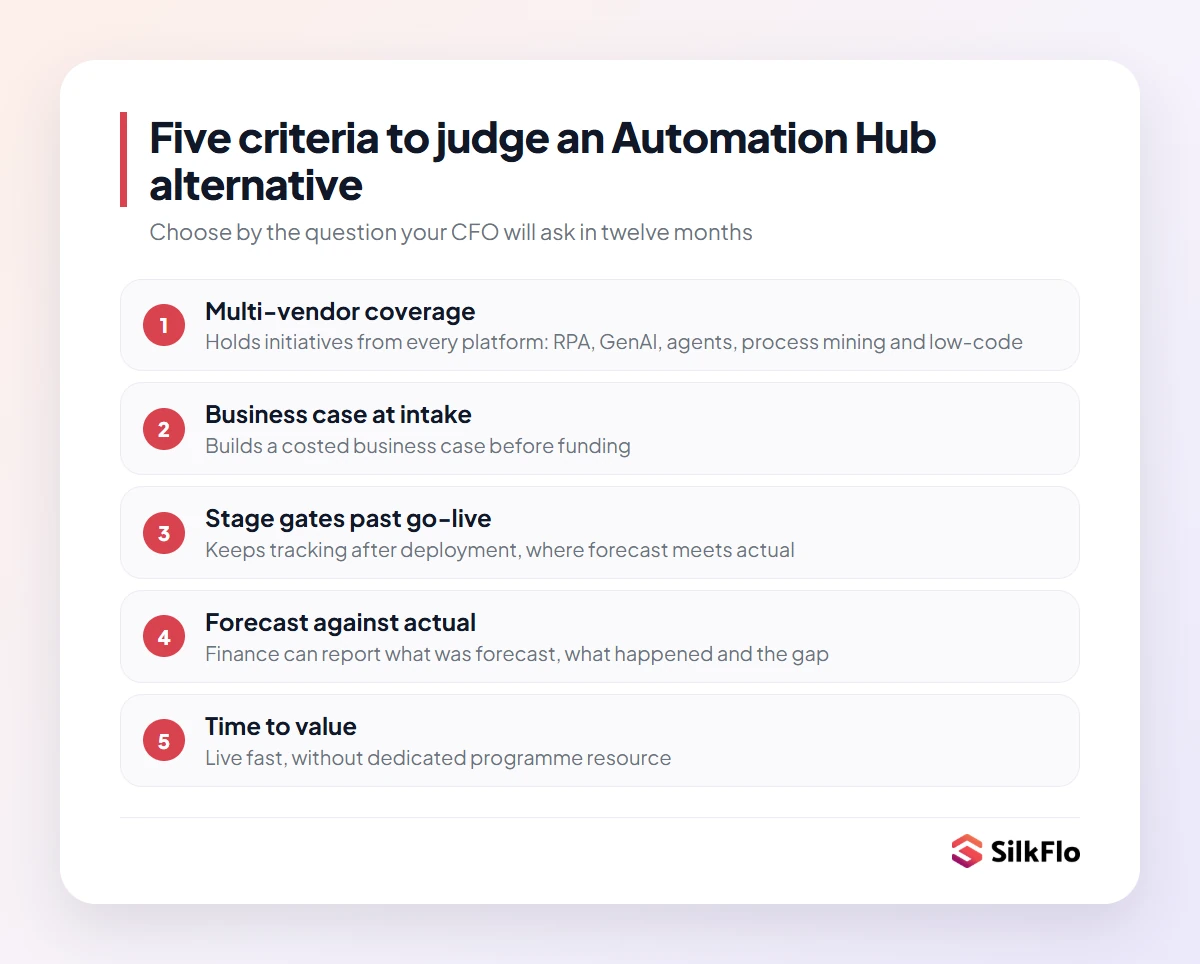
Choose by the question your CFO will ask in twelve months, not by the feature list. Five criteria matter.
- Multi-vendor coverage. Can it hold initiatives from every platform: RPA, GenAI, agents, process mining and low-code? A tool that covers one or two vendors recreates the problem.
- Business case at intake. Does it help build a costed business case before funding? Weak intake funds science projects that only show up at the post-implementation review.
- Stage gates past go-live. Most tools stop tracking at deployment. The checkpoint that matters is the one after it, where forecast meets actual.
- Forecast against actual. Can finance pull a report a year after go-live showing what the business case forecast, what actually happened and where the gap is? If not, it is a pipeline tracker, not ROI tracking.
- Time to value. Enterprise portfolio platforms can take a long time to implement and need dedicated programme resource. For a CoE that needs answers now, speed matters as much as depth.
The alternatives at a glance
| Tool | Multi-vendor | Business case at intake | Stage gates | Forecast vs actual | Best for |
|---|---|---|---|---|---|
| SilkFlo | Yes, 20+ integrations | Yes, AI-assisted | Yes | Yes, from your own data | Multi-vendor portfolios that need P&L evidence |
| Microsoft Power Platform CoE Starter Kit | Microsoft only | No | Partial | No | Microsoft-first estates |
| Automation Anywhere CoE Manager Plus | AA, UiPath and Power Automate | No | Yes | Savings from automation run data | Mixed RPA estates |
| Planview | Partial | No | Yes | Programme level | Large enterprise programme governance |
| ServiceNow Strategic Portfolio Management | Partial | No | Yes | Project budget level | ServiceNow-led enterprises |
1. SilkFlo: best for multi-vendor portfolios that need P&L evidence
SilkFlo is built for this problem. It sits above the execution tools and holds every AI and automation initiative in one portfolio, whichever vendor delivers it. It integrates with UiPath, Power Automate, Blue Prism, Automation Anywhere, Microsoft 365, Salesforce, ServiceNow, Jira and more, and tracks value across Copilot, Agentforce, GenAI and agents.
Tracking starts at intake. Staff describe an idea in plain words, and AI classifies it, fills the form and seeds an ROI estimate. Twenty ready-made solution templates prefill typical costs and benefits. After go-live, run data from your RPA platforms feeds the same value tracking, and actuals from any other system are pushed in live through the SilkFlo API, so the forecast-vs-actual comparison updates itself. Realised value is recorded against each business case, and every change is logged.
Before SilkFlo, Aviva UK’s Claims Innovation team ran strategy in Planview and ideation on Miro post-it boards, with no way to forecast, prioritise ideas or track benefits. Using SilkFlo, the team qualified 102 opportunities worth £12 million in cost-saving opportunities in three weeks, for £865 against £75,600 for a traditional consulting approach.
- Best for: portfolios across two or more vendors where the CFO, COO or board needs evidence of return. Strong fit for financial services, insurance and the public sector.
- Limitations: SilkFlo governs and tracks value. It does not replace Jira, ServiceNow or Azure DevOps for delivery management; it sits above them.
- Time to value: live in days, not a long implementation programme.
2. Microsoft Power Platform CoE Starter Kit: best for Microsoft-first estates
The CoE Starter Kit is a free collection of components from Microsoft for governing Power Platform at scale. It covers environment management, app lifecycle, adoption monitoring and compliance for Power Automate and Power Apps, and shows which environments are active, who is building what and where licences go.
It cannot see UiPath bots, Salesforce automations or GenAI tools built outside Microsoft. It has no business case generation and no way to check whether flows delivered the savings expected.
- Best for: Microsoft-centric estates that want governance with no licence cost. Often used as a base layer with a value tracking tool on top.
- Limitations: needs internal IT time to set up and maintain. Not enough on its own for a multi-vendor portfolio with P&L accountability.
- Pricing: free; budget for internal build and upkeep.
3. Automation Anywhere CoE Manager Plus: best for mixed RPA estates
CoE Manager is Automation Anywhere’s governance tool for automation programmes. The Plus edition adds integrations that, according to Automation Anywhere’s documentation, connect to UiPath environments and Power Automate environments to monitor automations and calculate achieved savings. For teams running Automation Anywhere alongside UiPath, it gives one pipeline instead of two, with idea crowdsourcing and stage-gate approvals similar to Automation Hub.
Its savings come from automation run data rather than finance data, and its strength is the RPA estate. GenAI tools, agents and custom models need checking case by case.
- Best for: portfolios spanning Automation Anywhere with UiPath or Power Automate.
- Limitations: RPA-centred; savings figures are not reconciled to the P&L.
- Pricing: enterprise contracts.
4. Planview: best for large enterprise programme governance
Planview is a strategic portfolio management platform for IT, transformation and capital portfolios. It covers demand management, capacity planning and portfolio financials across every kind of initiative, not just automation, and many large organisations already have it under contract.
For AI ROI, the limits are specific. Financial data tends to sit at programme level rather than initiative level, and there is no built-in check on whether a given AI initiative delivered its savings. Aviva’s experience above is typical: strong for strategy, with ideas, forecasts and benefit tracking handled elsewhere.
- Best for: enterprises already running Planview for IT portfolio governance that want AI initiatives inside it.
- Limitations: significant implementation effort; no initiative-level forecast-vs-actual review for AI.
- Pricing: enterprise contracts.
5. ServiceNow Strategic Portfolio Management: best for ServiceNow-led enterprises
ServiceNow SPM is the portfolio module of the Now Platform, covering demand intake, project governance, resourcing and portfolio reporting. For enterprises already deep in ServiceNow, it avoids adding another vendor.
It tracks delivery status, resources and project budgets. It does not track financial outcomes per AI initiative, build AI business cases or check delivered savings against the P&L, and bringing in initiatives from other platforms needs integration work.
- Best for: enterprises running ServiceNow whose main need is delivery visibility.
- Limitations: not built for AI ROI; initiative-level value tracking needs custom work.
- Pricing: Now Platform licence plus the SPM module.
What is the Microsoft CoE Toolkit for, and how does it compare with Automation Hub?
They solve different halves of the same problem. The CoE Starter Kit governs the Power Platform itself: environments, makers, apps, flows and licences. Automation Hub governs the pipeline of UiPath automation ideas, from submission to deployment. Neither tracks value across vendors after go-live. Teams running both often end up with two partial views and a spreadsheet in between, which is the gap a vendor-neutral portfolio tool fills.
How do we govern a multi-vendor AI and automation portfolio?
Put one layer above the execution platforms rather than trying to stretch any single vendor’s tool across the others.
- One register. Every initiative, from every platform, in one place with an owner and a status.
- One intake. All new ideas come in the same way and get a costed business case before funding.
- One set of gates. The same approval stages for every initiative, including a review after go-live.
- One source of actuals. Results come from your own finance and operational data, with platform run data as supporting evidence.
- One report. Forecast against actual across the whole portfolio, monthly.
Is a spreadsheet or homegrown tracker enough to run our AI portfolio?
For a handful of initiatives, yes. Past twenty or so, across several platforms and teams, spreadsheets break down: versions multiply, nobody owns the master, actuals are pasted in by hand and the audit trail disappears. The usual sign is a steering committee report that someone rebuilds by hand every month.
How to choose
- Several vendors, and the board will ask what it delivered: SilkFlo. It is the only tool here that tracks every vendor and compares forecast with actual from your own data.
- Mostly Microsoft Power Platform: the CoE Starter Kit, then add a value layer when the portfolio grows beyond Microsoft.
- Automation Anywhere with UiPath or Power Automate: CoE Manager Plus covers the RPA estate.
- Planview or ServiceNow already in place: extend the contract for delivery tracking, then deal with initiative-level value separately.
The test that separates a pipeline tracker from an ROI tool is simple: did the forecast savings show up in the P&L? To work out what a business case should promise in the first place, use the free AI ROI calculator. For the measurement method behind it, see how to measure AI ROI. To see SilkFlo’s portfolio view, book a SilkFlo demo.
Frequently Asked Questions
UiPath Automation Hub alternatives
Is a spreadsheet or homegrown tracker enough to run our AI portfolio?
For a handful of initiatives, yes. Across many initiatives, platforms and teams, spreadsheets lose version control, ownership and the audit trail, and reporting turns into a monthly manual rebuild.
Can value tracking pull run data from our RPA, ServiceNow and Jira automatically?
In SilkFlo, yes. It integrates with UiPath, Blue Prism, Automation Anywhere, Power Automate, ServiceNow and Jira, RPA run data feeds value tracking, and any other system can push actuals through the SilkFlo API.
How do we govern a multi-vendor AI and automation portfolio?
Put one layer above the platforms: one register, one intake with a business case, one set of approval gates including a post-go-live review, actuals from your own data and one monthly forecast-vs-actual report.
What is the Microsoft CoE Toolkit for, and how does it compare with Automation Hub?
The CoE Starter Kit governs the Power Platform: environments, makers, apps, flows and licences. Automation Hub governs the pipeline of UiPath automation ideas. Neither tracks value across vendors after go-live.
What are the alternatives to UiPath Automation Hub?
The main ones are SilkFlo, the Microsoft Power Platform CoE Starter Kit, Automation Anywhere CoE Manager Plus, Planview and ServiceNow Strategic Portfolio Management. SilkFlo is the one built to track every vendor and compare forecast with actual benefit from your own data.
Azure DevOps, Microsoft, Microsoft Copilot, Microsoft Power Automate and Microsoft Power Platform are trademarks of the Microsoft group of companies.